


The following key points should be emphasized during the installation of the excitation controller 3BHE046836R0101 GFD563A101, summarized based on ABB official specifications and actual engineering practice:
1. Environment and Installation Conditions
Physical Environment:
Install in a well-ventilated cabinet free from severe vibration and strong electromagnetic radiation. Avoid direct sunlight, rain, and high temperature and humidity environments (operating temperature -20℃~60℃, humidity 5%~95% non-condensing, protection rating IP20).
Leave at least 5cm of ventilation space around the module. Use standard DIN rails for installation and ensure a secure fit to prevent loosening during operation.
Electrical Compatibility:
The power supply voltage must be consistent with the site conditions to avoid damage due to voltage mismatch. Signal lines and power lines should be laid separately (spacing ≥200mm). When crossing, they should cross perpendicularly and the signal line should be shielded.
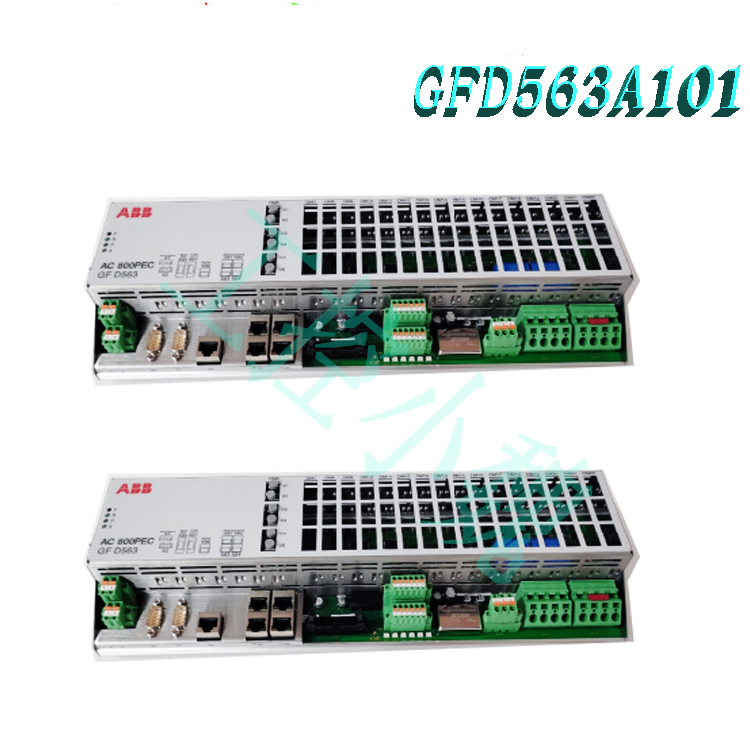
Grounding requires a ≥4mm² grounding wire connected to the protective ground (PE). Secure the module frame through the mounting holes and use toothed washers to ensure good electrical grounding. Protection and Temperature/Humidity: The module has an IP20 protection rating (compliant with IEC 60529) and must be installed in a well-ventilated cabinet free from severe vibration and strong electromagnetic radiation, avoiding direct sunlight and rain. Operating temperature range: -20℃ to 60℃ (up to 55℃ continuous operation in some scenarios), relative humidity: 5% to 95% (non-condensing), ensuring the environment meets the harsh conditions of high temperature, high humidity, and other environmental factors common in industrial settings.
Heat Dissipation and Space: At least 5cm of clearance must be left during installation to prevent module failure due to poor heat dissipation. Use standard DIN rail mounting to ensure a secure installation and prevent module loosening due to vibration during operation.
Cleaning and Protection: Regularly clean dust and debris from the module surface to avoid affecting heat dissipation and signal transmission.
2. Pre-Installation Preparation
Power Disconnection and Safety:
Before operation, the power must be completely disconnected and verified to have no residual voltage (if capacitor discharge, wait ≥5 minutes). Use anti-static tools (wrist strap, anti-static bag) to avoid electrostatic damage.
.jpg)
Electrical work must be performed by qualified electricians wearing safety shoes, gloves, and other protective equipment, and following safety procedures such as lockout tagging (LOTO).
Compatibility Confirmation:
New modules must be compatible with the original system (firmware version, interface protocol, physical dimensions). ABB original or certified compatible modules are preferred.
Power Supply and Voltage: Before wiring, confirm that the module’s power supply voltage (24VDC, typical power consumption 190mA) matches the site power supply to avoid voltage mismatch that could burn out the module. The power ground and UPS power ground must be connected to the same ground to ensure equipotential bonding.
Signal and Power Line Separation: Signal cables (such as sensor and communication cables) should be laid separately from power cables, ideally with a distance of at least 200mm to reduce electromagnetic interference; if they cross, they must cross perpendicularly and be shielded, with both ends of the shield grounded.
Grounding Specifications: System ground and shield ground must be connected separately to the grounding grid. Sharing cabinet bolt grounding is prohibited; dedicated grounding screws and grounding wires must be used. Grounding resistance must meet DCS system requirements and be rigorously measured and verified. The cabinet grounding should be secure and reliable, and the connections should be coated with anti-corrosion paint.
Communication and Parameter Configuration
Protocol and Interface: Supports PROFIBUS DP-V1 protocol (master-slave mode), expandable to PROFINET, EtherNet/IP, Modbus TCP/RTU, etc. Equipped with two PROFIBUS DP ports (DB9 female connector), supporting line redundancy and adaptive transmission rate (9.6kbps to 12Mbps).
Parameter Configuration: Before commissioning, communication protocol, signal type, node address, and other parameters must be configured using ABB’s dedicated commissioning software or the main control system to ensure consistency with system requirements. For example, the communication rate setting must match the target device, and error detection uses CRC or BCC checksums.
Redundancy and Fault Handling: Supports master station redundancy and line redundancy; automatically switches to the backup port in case of a master port failure. Communication status is displayed via indicator lights (solid fill indicates normal, flashing indicates no communication established); faults should be investigated in conjunction with logs.
.jpg)
3. Installation Steps and Operation
Wiring Specifications:
Before wiring, check the terminals for secure connection to avoid poor contact; use Phoenix terminals (plug-in type) for signal interfaces to improve efficiency, and use RJ45 for Ethernet interfaces.
Excitation cables (0.2-4mm²) and control cables (0.2-2.5mm²) should be routed separately to avoid electromagnetic interference.
Configuration and Commissioning:
Configure parameters (such as excitation curve, protection threshold, and communication protocol) using ABB dedicated software (such as UNITROL Configurator, Drive Composer) to ensure they match the generator and system requirements.
Before commissioning, perform a no-load test to verify the stability of excitation current and voltage, and protection functions (such as overcurrent and overvoltage triggering). Run at full load for at least 24 hours to monitor parameters such as temperature and vibration.
4. Safety and Protection Measures
System Protection:
The module has built-in multiple protections including overvoltage, undervoltage, overcurrent, and overheating. These must be checked regularly to ensure proper functioning. The mains side must comply with harmonic standards such as IEC 61000-2-4.
The emergency stop function must comply with IEC 60204/ISO 13850. The manual trigger device must be clearly user-friendly and operable without referring to the manual.
Residual Hazard Prevention:
Before operation, disconnect all voltage sources and use a multimeter (impedance ≥1MΩ) to verify that the terminal voltage to ground is close to 0V. After capacitor discharge, wait ≥5 minutes before operation.
Warning labels should be affixed to the cabinet door to prevent accidental contact with live parts. The rotor excitation winding and the secondary side of the excitation transformer require additional protection.
Functional Safety: Complies with IEC 60204, ISO 12100, IEC 62061 SIL CL2, and ISO 13849-1 PLd safety standards. The safety function STO (Safe Torque Off) must be implemented through a safety circuit to prevent unexpected system restarts and ensure functional safety.
Protection functions: Built-in overcurrent, overvoltage, and overheat protection mechanisms, enhanced dynamic response (such as forced excitation function), quickly adjust the excitation current to improve system stability in the event of a power grid short circuit or sudden load changes.
Emergency operation: The emergency stop function must be manually triggered, conforming to IEC 60204, ensuring rapid shutdown and avoiding dangerous situations. In case of a fault, power must be disconnected before troubleshooting; live operation is prohibited.
5. Post-installation maintenance and backup
Regular inspections:
Tighten internal cable connections, measure insulation resistance, and clean dust from module surfaces every six months; power management requires quarterly UPS discharge and redundant power supply switching testing.
Operating logs and configuration parameters (such as XML/binary files) must be regularly backed up to secure storage or the cloud (such as ABB Ability™), supporting version traceability.
Troubleshooting:
When a fault occurs, disconnect the power first before troubleshooting to avoid operating with power on. After replacing a module, restore the backup parameters and verify performance consistency through functional testing.
Installation Steps: Use DIN rail mounting. Disconnect the power and release static electricity before wiring. Connect the power supply, signal lines, and communication interfaces, ensuring secure terminal connections. After installation, check all connections for correctness to avoid poor contact.
Debugging and Testing: Configure parameters and perform functional tests using ABB debugging software or the main control system to verify voltage regulation, reactive power control, stability control, and other functions. Perform insulation tests and performance calibrations regularly to ensure compliance with design requirements.
Maintenance and Inspection: Tighten internal cable connections every six months, measure insulation resistance regularly, and check interface status and indicator light operation. Software updates must be performed through official channels to avoid compatibility issues.
6. Special Scenario Adaptation
New Energy/Industrial Scenarios:
In wind power/energy storage systems, ensure grid synchronization and low harmonic output; in industrial drive scenarios (such as rolling mills and hoists), pay attention to multi-motor phase synchronization and energy sharing.
The module supports expanded I/O (e.g., 30 digital inputs + 28 digital outputs) and multiple communication protocols (Profibus, Modbus), adapting to complex system integration.
Compatibility and Expandability
System Integration: As the core module of the AC 800PEC control system, it supports integration with PLC, DCS, and other systems, adapting to scenarios such as multi-motor coordination and energy feedback. Expandable I/O functions (e.g., analog/digital signal combinations) adapt to complex application requirements.
Modular Design: Supports hot-swapping and online maintenance, but ensure the power is off during installation. The modular structure facilitates rapid replacement and upgrades, reducing downtime.
In summary, installing 3BHE046836R0101 GFD563A101 requires strict adherence to electrical safety, environmental compatibility, communication configuration, and protection mechanisms to ensure efficient and stable system operation while meeting the stringent requirements of industrial scenarios.
Related product recommendations:
PPD517A3011 3BHE041576R3011
PPD517 3BHE041576R3011
3BHE040375R103E PPD115
PPD539A102 3BHE039770R0102
3BHE057901R0101 PCD235
3BHE039724R0C3D PPD513AOC-100440
PCD235C101 3BHE057901R0101
GFD563A102 3BHE046836R0102
GFD233A101 3BHE022294R0101
GFD563A101 3BHE046836R0101
GFD563A102 3BHE046836R0102
GF D563 3BHE046836R010
PPD512 A10-15000 3BHE040375R1023
More……
Excellent work! Looking forward to future posts.
This is exactly the kind of content I’ve been searching for.
This post cleared up so many questions for me.
You always deliver high-quality information. Thanks again!
I enjoyed every paragraph. Thank you for this.
This was so insightful. I took notes while reading!
Thanks for taking the time to break this down step-by-step.
This gave me a whole new perspective on something I thought I already understood. Great explanation and flow!
I’ll definitely come back and read more of your content.
This topic is usually confusing, but you made it simple to understand.
I never thought about it that way before. Great insight!
This post cleared up so many questions for me.
Such a simple yet powerful message. Thanks for this.
You write with so much clarity and confidence. Impressive!
I learned something new today. Appreciate your work!
You really know how to connect with your readers.
I feel more confident tackling this now, thanks to you.
I hadn’t considered this angle before. It’s refreshing!
Such a refreshing take on a common topic.
Your writing always inspires me to learn more.
I wasn’t expecting to learn so much from this post!
Posts like this are why I keep coming back. It’s rare to find content that’s simple, practical, and not full of fluff.
Excellent work! Looking forward to future posts.
I wasn’t sure what to expect at first, but this turned out to be surprisingly useful. Thanks for taking the time to put this together.
Thank you for making this topic less intimidating.
This is one of the best explanations I’ve read on this topic.
Great post! I’m going to share this with a friend.
What an engaging read! You kept me hooked from start to finish.
This content is really helpful, especially for beginners like me.
This topic really needed to be talked about. Thank you.
I enjoyed your perspective on this topic. Looking forward to more content.
The way you write feels personal and authentic.
You clearly know your stuff. Great job on this article.
The way you write feels personal and authentic.
This helped clarify a lot of questions I had.
Your writing style makes complex ideas so easy to digest.
You’re doing a fantastic job with this blog.
It’s great to see someone explain this so clearly.
Thanks for addressing this topic—it’s so important.
Thanks for sharing your knowledge. This added a lot of value to my day.
I’m definitely going to apply what I’ve learned here.
I appreciate the real-life examples you added. They made it relatable.
This was incredibly useful and well written.
I enjoyed your take on this subject. Keep writing!
I appreciate how genuine your writing feels. Thanks for sharing.
You clearly know your stuff. Great job on this article.
I love how practical and realistic your tips are.
This was a very informative post. I appreciate the time you took to write it.
I love how practical and realistic your tips are.
Your advice is exactly what I needed right now.
I’ve bookmarked this post for future reference. Thanks again!
You explained it in such a relatable way. Well done!
I appreciate the honesty and openness in your writing.
Excellent work! Looking forward to future posts.
Thank you for sharing this! I really enjoyed reading your perspective.
I agree with your point of view and found this very insightful.
This helped clarify a lot of questions I had.
I appreciate the honesty and openness in your writing.
I love how clearly you explained everything. Thanks for this.
This was incredibly useful and well written.
This gave me a whole new perspective on something I thought I already understood. Great explanation and flow!
I’ve read similar posts, but yours stood out for its clarity.
Such a simple yet powerful message. Thanks for this.
Your content always adds value to my day.
Thank you for putting this in a way that anyone can understand.
Excellent work! Looking forward to future posts.
Your advice is exactly what I needed right now.
It’s refreshing to find something that feels honest and genuinely useful. Thanks for sharing your knowledge in such a clear way.
Your content always adds value to my day.
Way cool, some valid points! I appreciate you making this article available, the rest of the site is also high quality. Have a fun.