
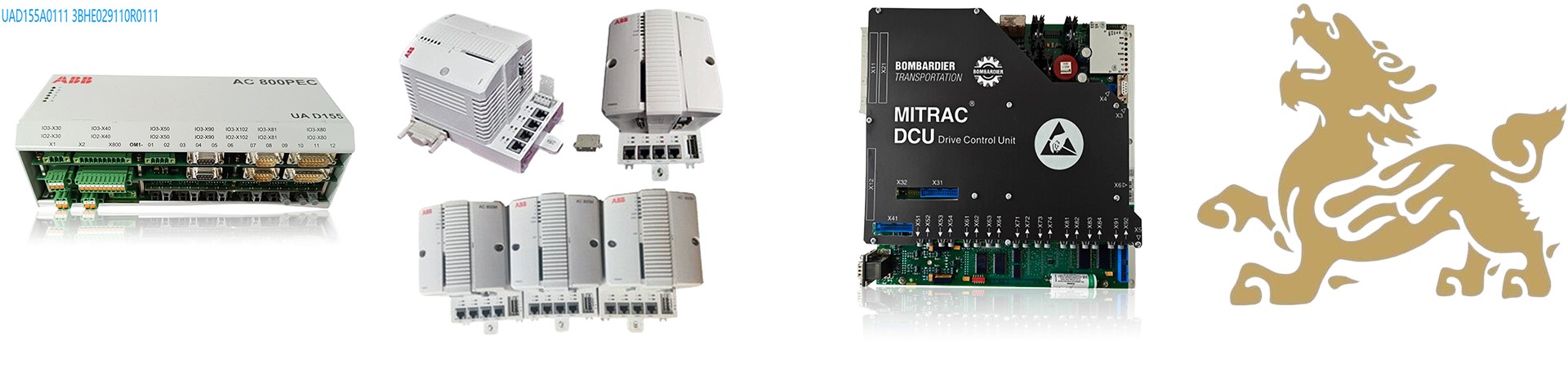

Communication Interface and Protocol Support
Interface Type:
Communication Interface: Supports protocols such as PROFINET, Modbus TCP/RTU, Ethernet/IP, and IEC 61850. Equipped with 4 Ethernet ports (RJ45) and 2 RS485/RS232 interfaces, allowing seamless integration with DCS/PLC, host computers, or third-party devices (such as ABB 800xA systems).
Monitoring Interface: 10V DC output for real-time monitoring of excitation current, fed back to the controller via a high-precision shunt (e.g., 100mV/A).
Power Supply Interface: 24V DC power supply (±10% voltage fluctuation allowed), redundant power input design to ensure stable system operation.
I/O Expansion: Supports 24-point I/O expansion, compatible with ABB S800/S900 series I/O modules, adaptable to different application scales.
Redundant Bus: Employs a fiber optic redundant bus (such as Modbus Plus) to connect I/O clusters or ABB drives, supporting hot standby switching (switching time ≤20ms) to ensure uninterrupted system operation.
Protocol Compatibility:
Supports integration with OPC UA, ABB Ability™ platform, and 800xA systems. Can be linked with ABB S800/S900 I/O modules and safety function modules to build a complete control system.
Compatible with third-party devices (such as Schneider Quantum and Triconex TMR systems), enabling cross-platform communication through gateways or protocol converters.
Link Establishment Steps
Hardware Connection:
Physical Installation:
Installed in an industrial standard control cabinet, meeting IP20 protection requirements. Operating temperature: -25°C to +70°C. Avoid high temperature, high humidity, and strong electromagnetic interference environments.
.jpg)
Module dimensions: 120mm × 180mm × 60mm, weight: approximately 0.5kg. Supports rack mounting; ensure sufficient heat dissipation space and maintenance access.
Power Supply Configuration: Employs 24V DC power to ensure stability, and includes redundant power modules for enhanced reliability.
Communication Protocol and Network Configuration
Protocol Compatibility: Supports Ethernet/IP, Modbus TCP/RTU, Profinet, IEC 61850 MMS/GOOSE, and is compatible with OPC UA standards. Seamlessly integrates with ABB 800xA systems, DCS/SCADA platforms, and third-party devices (such as PLCs and HMIs).
Configuration Steps:
IP Address Setting: Configure the module’s IP address, subnet mask, and gateway using the ABB Control Builder M tool, ensuring it is on the same network segment as the host.
Baud Rate Adjustment: Supports 1200-19200bps (RS485) or 10M/100M adaptive Ethernet, requiring consistent communication parameters with the host.
Redundancy Configuration: Enables dual-channel hot standby mode; primary and backup channel data synchronization cycle ≤1ms; automatic failover in case of failure (switching time ≤20ms).
Communication Parameter Configuration:
Network Settings: Configure IP address, subnet mask, and gateway in ABB Control Builder M software, and select the communication protocol (e.g., Ethernet/IP, Modbus TCP).
.jpg)
Serial Port Parameters: Set serial port parameters (baud rate, data bits, stop bits) using PLC programming software (e.g., Codesys) to match host communication settings.
Redundancy Configuration: Enable dual-channel hot standby function, configure primary/standby channel switching logic and fault detection mechanism.
Software Integration:
Engineering Tools: Use ABB Control Builder M for system engineering design, supporting IEC61131-3 language programming to deploy excitation control logic.
Host Computer Communication: Link with SCADA system and HMI panel via OPC UA or ABB Ability™ platform to achieve remote monitoring and parameter adjustment.
Communication Protocol Configuration and Host Connection
Protocol Configuration:
Configure communication parameters (such as IP address, baud rate, protocol type) using ABB Control Builder M engineering tools to ensure protocol compatibility with the host (such as DCS/PLC).
Supports OPC UA standard, enabling connection to the ABB Ability™ platform for remote monitoring and data exchange.
Data Interaction:
Achieves bidirectional data transmission with the host via Ethernet or serial port, including excitation current setpoint, actual value, status signals, and fault alarm information.
Redundancy Design: Dual network port configuration supports hot standby switching; automatically switches to the backup channel in case of primary channel failure (switching time ≤100ms), ensuring communication continuity.
Drive Mechanism and Function Implementation
Drive Configuration and Excitation Control
Excitation Regulation Function:
Precisely controls the generator/motor excitation current using a PID algorithm, maintaining terminal voltage fluctuation ≤±0.5%, supporting multiple control modes such as constant voltage, constant power factor, and constant reactive power.
Output Range: 0-200V AC (output voltage), 0-20A (output current), adaptable to the needs of synchronous generators of different capacities.
Protection and Monitoring:
Integrates overcurrent, overvoltage, undervoltage, and overheat protection functions; supports COMTRADE fault recording (≥1000 event records) and self-diagnostic functions.
Monitors excitation current, voltage, and system status, providing real-time feedback on operating information through LED indicators and fault logs.
Parameter Configuration:
Sets excitation current limits, PID parameters, communication addresses, etc., using engineering tools; supports online parameter adjustment and firmware upgrades.
Protection and Monitoring:
Fault Protection: Integrates overcurrent, overvoltage, undervoltage, and frequency anomaly protection; automatically trips and performs rapid demagnetization upon triggering to protect generator safety.
Self-Diagnostic Function: Supports COMTRADE fault recording (≥1000 event records), providing real-time feedback on system status through LED status indicators and a remote monitoring platform.
Expandability:
Modular Design: Supports I/O module expansion (e.g., S800/S900 series), adapting to the needs of generator sets from small to large.
FPGA Acceleration: Utilizes FPGA technology to achieve parallel processing of protocol parsing and application functions, improving control response speed (algorithm cycle as low as 100μs).
.jpg)
Installation, Commissioning, and Maintenance Specifications
Installation Steps:
Check module integrity, confirm model and serial number match the order, and read the technical manual.
Select a stable, vibration-free installation location, ensuring sufficient space for heat dissipation and maintenance access.
Connect power, signal lines, and communication interfaces, avoiding looseness or short circuits. Verify the power supply voltage using a multimeter.
Configure communication protocols and parameters, and perform stand-alone functional tests (e.g., excitation current regulation, PID control).
Integration Testing: Connect to the host system to verify data transmission, control logic, and protection functions, ensuring stable system operation.
Installation and Commissioning:
Pre-Power-On Checks: Verify power supply voltage, grounding resistance (≤1Ω), and wiring tightness. Use a multimeter to test insulation resistance (≥50MΩ).
Functional Testing: After startup, observe the LED indicators (RUN/ALARM/TRIP). Test the excitation current regulation accuracy (error ≤±0.5%) and communication data transmission rate (≥10Mbps).
Integration Testing: Perform full system integration testing with the generator and speed governor to verify grid connection stability, black start capability, and protection logic.
Software Parameter Settings and Drive Logic:
Excitation Control Algorithm: Employs PID closed-loop control, maintaining generator terminal voltage fluctuations ≤±0.5% by adjusting the excitation current. Supports switching between constant voltage, constant power factor, and constant reactive power modes.
Parameter Configuration:
Voltage Regulation Range: Adjust PID parameters (proportional gain, integral time, derivative time) to optimize dynamic response based on generator capacity settings (e.g., 1.0kN range).
Protection Thresholds: Set overvoltage/undervoltage, overcurrent, and frequency anomaly protection values. Upon triggering, automatically execute rapid demagnetization and interlocked circuit breaker tripping.
Communication Mapping: Configure I/O variable address mapping (e.g., Modbus register address) to ensure the host can read excitation current, voltage, and status information in real time.
Maintenance Points:
Regularly check the power supply, connection lines, and communication interface status. Perform firmware upgrades and performance calibration annually.
Fault Handling: Utilize self-diagnostic functions to locate fault points and analyze causes using fault logs. ABB technical support provides spare parts and on-site commissioning services.
Safety Procedures: Before operation, disconnect power and confirm there is no residual voltage. Use insulated tools and protective equipment to avoid electrostatic damage to components.
System Integration and Collaboration:
Generator Collaboration: As the main control unit of the UNITROL 6000 series, it connects directly to the synchronous generator rotor windings. It generates thyristor trigger signals via a pulse trigger board (PTB) to control the rectifier bridge output.
System Integration and Collaboration:Governor Integration: Works in conjunction with the turbine governor to optimize dynamic balance between power generation and load, supporting rapid excitation recovery in black-start scenarios.
DCS/PLC Integration: Communicates with DCS/PLC systems via OPC UA or IEC 61850 protocol to achieve remote parameter adjustment, status monitoring, and fault early warning.
Typical Application Scenarios and Cases:
Power Industry: Excitation control of coal-fired/gas-fired/hydropower generators, working with turbine governors to optimize dynamic balance between power generation and load; dynamic reactive power compensation and black-start support in substations.
Industrial Sector: Motor control and protection in metallurgy (electric arc furnaces/rolling mills), petrochemicals (compressors/pump loads); automated control in port logistics (stall cranes/conveyor systems).
Special Scenarios:Precise control of rail transit traction systems and new energy microgrids (such as the ZEE600 system at the ABB Xiamen Industrial Center).
Special Scenarios: In summary, the PCD530A102 3BHE041343R0102 excitation control unit achieves a stable connection and drive with the host computer through hardware connection, communication protocol configuration, software parameter settings, and system integration. Its high-precision control, redundant design, and open communication protocol ensure efficient and reliable operation in power and industrial scenarios.
Recommended modules with the same function:
GFD563A101
GFD563A101 3BHE046836R0101
GFD563A102
GFD563A102 | 3BHE046836R0102
GFD212A 3BHE020357P201
GFD212A 3BHE020356R0101
GFD233A 3BHE022294R0103
GFD233A
GFD233A103
KUC321AE HIEE300698R1
3BHB004661R0101
PPD517A3011 3BHE041576R3011
PPD517 3BHE041576R3011
3BHE040375R103E PPD115
PPD539A102 3BHE039770R0102
3BHE057901R0101 PCD235
3BHE039724R0C3D PPD513AOC-100440
PCD235C101 3BHE057901R0101
GFD563A102 3BHE046836R0102
GFD233A101 3BHE022294R0101
GFD563A101 3BHE046836R0101
GFD563A102 3BHE046836R0102
GF D563 3BHE046836R010
PPD512 A10-15000 3BHE040375R1023
More……
Hello just wanted to give you a quick heads up. The words in your post seem to be running off the screen in Safari. I’m not sure if this is a formatting issue or something to do with web browser compatibility but I figured I’d post to let you know. The design and style look great though! Hope you get the issue resolved soon. Kudos
Hey there! I know this is kind of off topic but I was wondering which blog platform are you using for this website? I’m getting fed up of WordPress because I’ve had issues with hackers and I’m looking at options for another platform. I would be fantastic if you could point me in the direction of a good platform.