

PPD517A3011 3BHE041576R3011 Excitation Processing Unit ABB Configuration Guide
Hardware Installation and Physical Connections
Rack Installation: Deployed in a standard industrial rack, ensuring an operating temperature of 0~60℃ (optional -40~70℃ wide-temperature model), IP20 protection rating, with reserved space for heat dissipation and a forced air cooling system.
Power Supply Configuration: 24V DC logic power supply (fluctuation ≤ ±5%), redundant power modules supporting dual-channel switching to ensure system continuity.
Signal Interfaces:
Digital Output: 24V DC drives the excitation winding, output current ≥ 5A, supports PWM pulse triggering of thyristor/IGBT rectifier bridge.
Monitoring Interface: 10V DC real-time monitoring of excitation current (feedback via a high-precision shunt).
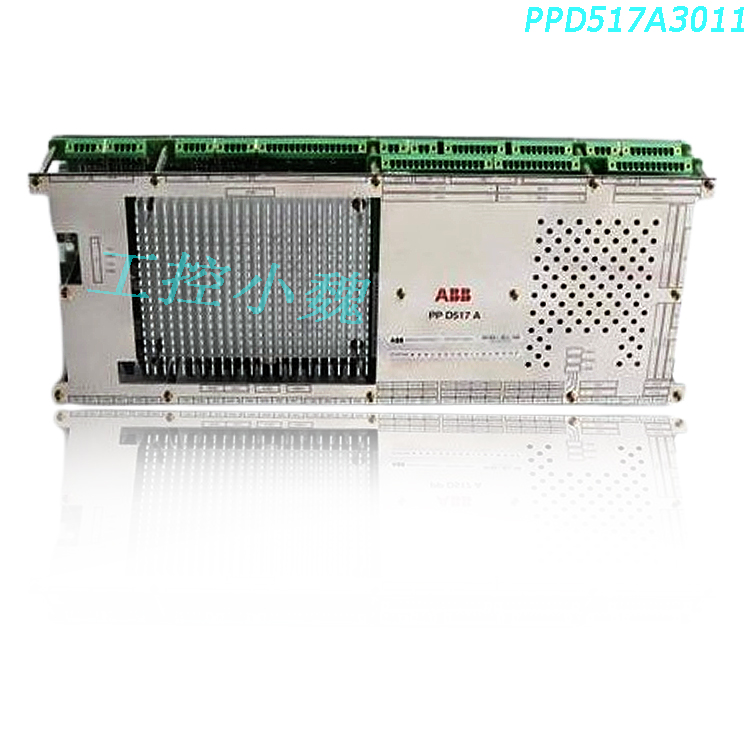
Communication Interfaces: Integrated Ethernet (supports Modbus TCP/IP, IEC 61850), RS485/RS232 (compatible with Profibus-DP), fiber optic redundant ring network (switching time ≤20ms).
Communication Protocols and Network Configuration
Protocol Support: Ethernet/IP, Modbus TCP/RTU, Profinet, IEC 61850 MMS/GOOSE, compatible with OPC UA standard, seamlessly integrated with ABB 800xA systems and DCS/SCADA platforms.
Configuration Steps:
IP Address Settings: Configure the module IP, subnet mask, and gateway using ABB Control Builder or Automation Builder tools, ensuring it is on the same network segment as the host.
Redundancy Configuration: Enable dual-channel hot standby mode, with a primary/standby channel data synchronization cycle ≤1ms, and automatic switching in case of failure (switching time ≤20ms).
Baud Rate Adjustment: The RS485 interface supports 1200-19200bps, which must be consistent with the host parameters.
Software Configuration and Parameter Settings
Excitation Control Algorithm:
Based on PID closed-loop control, maintaining generator terminal voltage fluctuation ≤ ±0.5%; supports switching between multiple modes such as constant voltage, constant power factor, and constant reactive power. PID parameters (proportional gain, integral time, derivative time) need to be tuned according to generator parameters (e.g., excitation current range 1.0kN).
Communication Protocol and Network Configuration:
Configure IP address, subnet mask, baud rate, and protocol parameters using ABB Control Builder M tool; redundant channel data synchronization period ≤ 1ms, automatically switching to the backup channel in case of failure (switching time ≤ 20ms).
.jpg)
Integrates Ethernet/IP, Modbus TCP/RTU, Profinet, and other protocols, supporting linkage with ABB I/O modules (such as S800/S900 series) and safety function modules.
Protection Thresholds: Set overvoltage/undervoltage, overcurrent, and frequency anomaly protection values; triggering executes fast demagnetization and interlocking circuit breaker tripping.
Communication Mapping: Configure I/O variable address mapping (e.g., Modbus register address) to ensure the host can read excitation current, voltage, and status information in real time.
Parameter Tuning: Optimize PID parameters (proportional gain, integral time, derivative time) using ABB Control Builder to adapt to the generator capacity (e.g., 1.0kN range excitation current).
Protection and Self-Diagnostic Functions:
Set overvoltage/undervoltage, overcurrent, and frequency anomaly protection thresholds; trigger these to execute rapid demagnetization and circuit breaker tripping; configure COMTRADE fault recording function to record ≥1000 event logs.
Enable self-diagnostic functions (e.g., LED status lights, system log) to monitor voltage/current parameters and module status in real time.
System Integration and Debugging
Generator Collaboration:
As the main control unit of the UNITROL 6000 series, it connects directly to the synchronous generator rotor winding, generating thyristor trigger signals via a pulse trigger board (PTB) to control the rectifier bridge output.
Optimizes dynamic balance between power generation and load in conjunction with the turbine governor, supporting rapid excitation recovery in black start scenarios.
Governor Integration: Optimizes dynamic balance between power generation and load in conjunction with the turbine governor, supporting rapid excitation recovery in black start scenarios.
DCS/PLC Integration: Enables remote parameter adjustment, status monitoring, and fault early warning via OPC UA or IEC 61850 protocol, supporting seamless integration with ABB 800xA systems.
Full System Integration Testing:
After startup, observe LED indicators (RUN/ALARM/TRIP) and test excitation current regulation accuracy (error ≤ ±0.5%) and communication data transmission rate (≥10Mbps).
Redundancy Design Verification: In case of a main channel failure, the backup controller automatically takes over with a switching time of <100ms, ensuring uninterrupted system operation.
Overvoltage/undervoltage and overcurrent protection tests: Ensures normal rapid demagnetization and circuit breaker tripping functions.
.jpg)
Maintenance and Optimization
Regular Maintenance:
Quarterly check the status of power modules, connection lines, and communication interfaces; clean the control cabinet every six months to ensure unobstructed cooling fans.
Annually perform firmware upgrades and performance calibrations to ensure the system complies with IEC 61508/61511 functional safety standards.
Fault Diagnosis and Handling:
Use self-diagnostic functions to locate fault points and analyze the causes based on fault logs; ABB technical support provides spare parts and on-site commissioning services.
Follow safe operating procedures: Disconnect power and confirm no residual voltage before maintenance; use insulated tools and protective equipment; avoid hot-plugging modules.
Commissioning and Maintenance Procedures
Installation and Commissioning:
Pre-power-on checks: Verify power supply voltage, grounding resistance (≤1Ω), wiring tightness, and insulation resistance ≥50MΩ.
Functional Testing: After startup, observe the LED indicators (RUN/ERR), test the excitation current regulation accuracy (error ≤±0.5%), and communication data transmission rate (≥10Mbps).
Joint Testing: Perform joint testing with the generator and speed governor system to verify grid connection stability, black start capability, and protection logic.
Maintenance Points:
Regular Inspections: Inspect power modules, connection lines, and communication interfaces quarterly; perform firmware upgrades and performance calibration annually.
Troubleshooting: Utilize self-diagnostic functions to locate fault points (e.g., COMTRADE fault recording), and analyze the cause based on fault logs; ABB technical support provides spare parts and on-site commissioning services.
Typical Application Scenarios and Expansion Capabilities
Power Industry: Excitation control for coal-fired/gas-fired/hydropower generators; dynamic reactive power compensation and black start support for substations.
Industrial Sector: Motor control and protection in metallurgy (electric arc furnaces/rolling mills), petrochemicals (compressors/pump loads), cement/steel/mining, and other industries.
Expansion Compatibility: Supports modular expansion (e.g., I/O modules, safety function modules) to adapt to the needs of generator sets from small to large; when integrating third-party equipment, verify communication protocol and electrical parameter compatibility.
Safety and Compatibility Assurance
Electromagnetic Compatibility (EMC): Passes IEC 61000-4 standard EMC testing, resisting surge, electrostatic discharge, and radio frequency interference.
Compatibility Verification: When integrating third-party devices, verify communication protocol and electrical parameter compatibility to avoid signal conflicts.
Safety Standards: Complies with IEC 61508/61511 functional safety standards, supports SIL 2 certification, ensuring safe system operation.
Summary: The PPD517A3011 3BHE041576R3011 excitation processing unit achieves high-precision excitation control and system reliability through hardware installation, communication configuration, software parameter settings, system integration, and safety specifications. During configuration, key attention should be paid to power supply stability, communication synchronization, and protection threshold settings. Combined with regular maintenance and fault diagnosis, efficient and stable operation in power and industrial scenarios is ensured.
PCD2000
PCD237A101
PCD237A101 3BHE028915R0101
PC D232 A|PEC80-CIO
8R37-2021-21-3101 PCD2000
PCD232A-3BHE022293R0101
PCD230A101
PCD230A101 3BHE022291R0101
PCD231B
PCD231B 3HHE025541R0101
PCD530A102
PCD530A102 3BHE041343R0102
PCD230A101
PCD230A101 3BHE022291R0101
PCD237
PCD287
PCD232A101
PCD232A101 3BHE022293R0101
PCD235B101 3BHE032025R0101
PCD235B101
PFSK165
PFSK165 3BSE027778R1
PFSK110
PFSK110 57310001-HG
PFSK108
PFSK108 YM322001-EH
PFSK106 YM322001-EC
PFSK111
PFSK111 5735175-C
PPD517A3011 3BHE041576R3011
PPD517A3011
PPD517 ABB
PPD517 3BHE041576R3011
PPD512A10-454000 3BHE040375R103E
3BHE040375R103E PPD115
PPD512A10-454000 |
PPD539A102 3BHE039770R0102
PPD539A102
more…..
I couldn’t resist commenting
I am sure this post has touched all the internet users, its really really pleasant article on building up new blog.