
Description
Many products are not yet listed. Please contact us for more product information.
If the product model differs from the displayed image, the model number shall prevail. Please contact us for specific product images; we will arrange to take photos in our warehouse for confirmation.
We have 76 shared warehouses worldwide, so it may sometimes take several hours to return an accurate result. We apologize for any inconvenience. Of course, we will respond to your inquiries as soon as possible.
Other names for MVI69-MNETF/W:
Input/Output Module MVI69-MNETF/W
MVI69-MNETF/W Analog Module
Redundancy Module MVI69-MNETF/W
The PROSOFT MVI69-MNETF/W control network communication module is a communication module designed by ProSoft Technology specifically for industrial automation. Belonging to the MVI69 series, it is mainly used for data exchange and system integration between PLCs (such as Allen-Bradley ControlLogix/CompactLogix) and external devices.
Technical Specifications and Functions
Protocol Support: Primarily supports Modbus TCP/IP (e.g., MVI69-MNET), Ethernet/IP, etc., and is compatible with Modbus serial (e.g., MVI69L-MBS supports RTU/ASCII mode). It can connect to instruments, frequency converters, HMIs, and other devices.
Hardware Features:
Modular design, adaptable to the 1769 standard slot, single-slot module size, 800mA@5VDC power consumption, operating temperature 0-60℃, storage temperature -40-85℃.
Supports real-time monitoring and remote access, with built-in LED indicators (e.g., module status, serial port activity, configuration status) for easy diagnostics.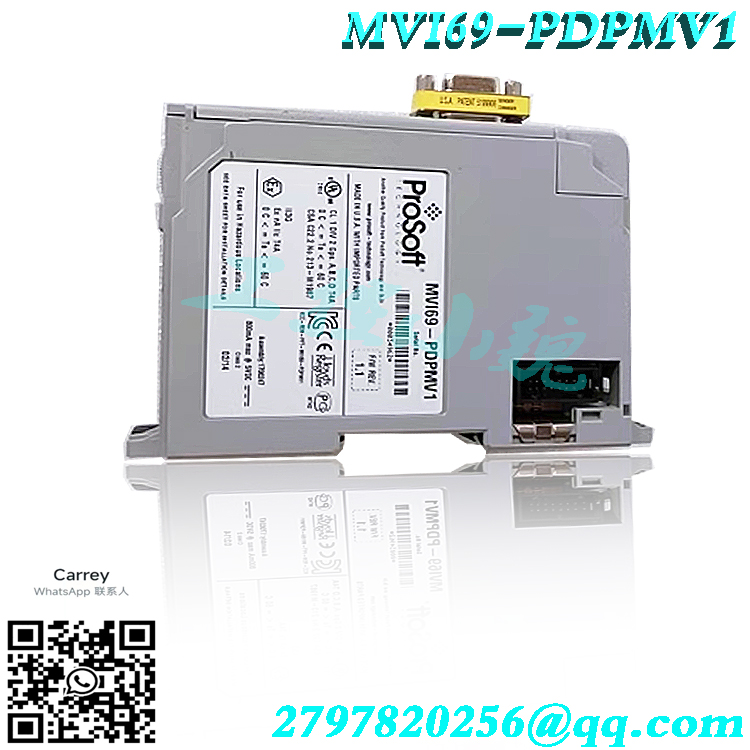
High data transfer rate, supports floating-point data movement and extensions for special protocols such as Enron/Daniel.
Software Tools: Comes with ProSoft Configuration Builder (graphical configuration tool), supports importing ladder logic examples, and can manage data via RSLogix 5000 tags and UDT.
Expansion Capabilities: Acts as a coprocessor to reduce PLC scan time, supports master/slave mode switching, and allows up to 30 Modbus commands in master mode.
Application Scenarios:
Industrial Automation:Widely used in production lines, SCADA systems, and remote I/O control, connecting PLCs to sensors, actuators, drives, flow computers, and other third-party devices.
Industry Cases:
Automotive Manufacturing: High-speed acquisition of analog/digital signals for real-time production line control.
Petrochemical Industry: Connects HART devices to DCS systems, supporting multi-protocol data fusion.
Power and Energy: Used for power grid monitoring and remote equipment status acquisition, compatible with Allen-Bradley’s next-generation controllers (such as ControlLogix 5580).
Expansion Capabilities: Supports Modbus master/slave mode, configurable with serial or Ethernet communication interfaces, and adaptable to upper-level systems such as SCADA and MES.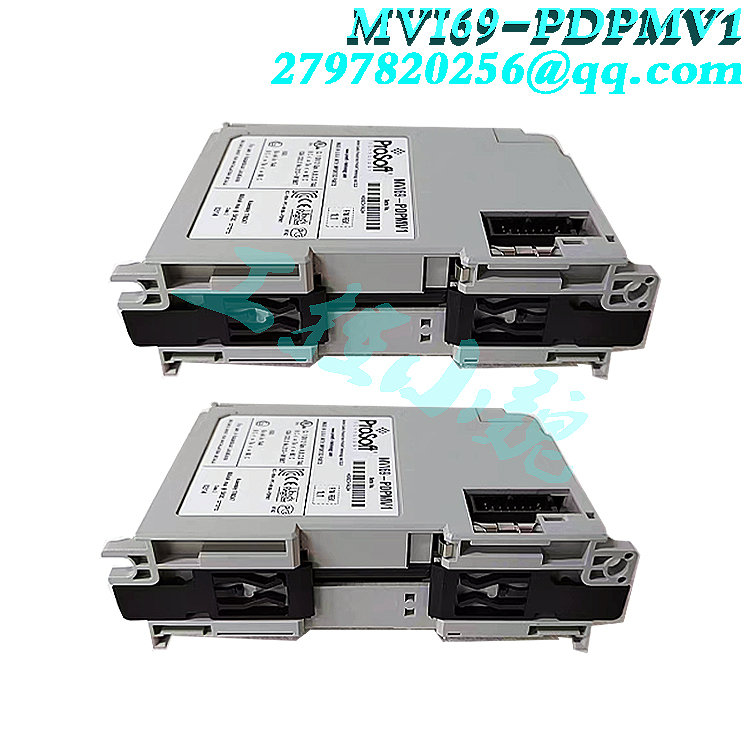
Compatibility and Upgrades
PLC Compatibility: Adapts to CompactLogix (1769 I/O bus version ≥16) and some MicroLogix systems. Tagging and diagnostics require RSLogix 5000 configuration.
Platform Compatibility: Designed specifically for Rockwell Automation’s CompactLogix/MicroLogix, compatible with ControlLogix 5380/5580 series, seamlessly integrated via EtherNet/IP or Modbus TCP/IP protocols.
Firmware and Configuration: ProSoft continuously updates firmware to support new controllers (firmware version matching with controller must be confirmed). Configuration must point to the processor (not the module) via CIP path to avoid module name conflicts.
Extension Modules: Can collaborate with other MVI69 series modules (such as MVI69-HART, MVI69-PDPMV1) to build multi-protocol communication networks.
Typical Applications:
Industrial Data Acquisition: Connects to pump stations, motors, sensors, and other equipment to achieve status monitoring and data reading (e.g., water treatment, energy management).
OEM Equipment Integration: Commonly used by machinery manufacturers for equipment networking, supporting SCADA system integration.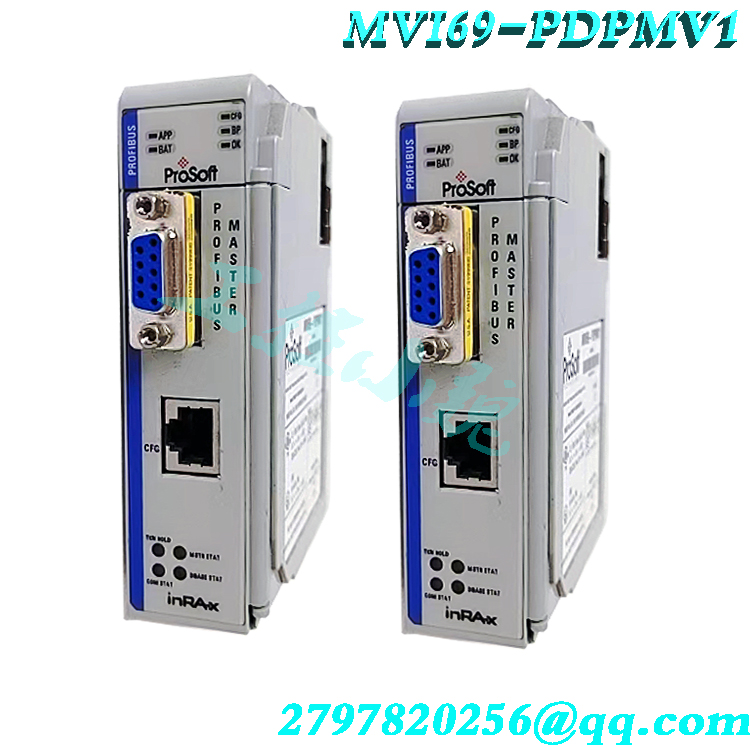
Protocol Conversion: Bridging devices with different protocols (e.g., Modbus to Ethernet/IP).
Installation and Troubleshooting
Installation Requirements:
Follow Class I, Division 2 electrical specifications, use Class 2 power supplies, ensure backplane power supply distance is ≤2 slots, and install a 1769-ECR termination module to terminate the bus.
During configuration, import the AOI (Add-On Instruction) into the PLC, ensure the processor is in RUN mode, and that “Inhibit Module” is not selected in the I/O configuration.
Troubleshooting:
Common issues include insufficient power, incorrect CIP path, module name mismatch, and bus not being terminated.
Diagnostic Steps: Check the power supply, processor status, module LED indicators, and configuration tool logs. If necessary, upgrade the firmware or re-import the AOI.
This module, with its high compatibility, stability, and flexible configuration capabilities, has become a key component for cross-protocol communication in industrial automation, suitable for diverse scenarios from upgrading traditional equipment to smart factories. Users are advised to design and debug their systems based on specific application needs and in conjunction with ProSoft’s official resources.
All products on this website are special products, and market prices are constantly fluctuating.
Please refer to customer service for a quote, as the price may not be accurate for new products.
Please confirm the model, product, price, and other detailed information with customer service before placing an order. This website is currently in use.
New products are available for sale; please contact customer service for further information.
Recommended related products:
PROSOFT PLX31-EIP-SIE
PROSOFT PLX31-EIP-SIE
PROSOFT MVI56E-MNETXT
PROSOFT MVI94-MCM-MHI
PROSOFT 5605-RIO-PDPS
PROSOFT 5604-RIO-PDPMV1
PROSOFT 5601-RIO-MCM
PROSOFT 5210-MNET-RIO
PROSOFT 5210-DFNT-RIO
PROSOFT 1452-25M
More……

Reviews
There are no reviews yet.