
Description
Many products are not yet listed. Please contact us for more product information.
If the product model differs from the displayed image, the model number shall prevail. Please contact us for specific product images; we will arrange to take photos in our warehouse for confirmation.
We have 76 shared warehouses worldwide, so it may sometimes take several hours to return an accurate product. We apologize for any inconvenience. Of course, we will respond to your inquiries as soon as possible.
DCC2223A 3EST125-977 Other Names:
Critical Safety Relay Module DCC2223A 3EST125-977
DCC2223A 3EST125-977 Control Unit
Input/Output Unit DCC2223A 3EST125-977
The DCC2223A 3EST125-977 is the core safety computer module of the Bombardier MITRAC series traction control system, designed specifically for rail vehicles such as subways and light rail, and complies with EN 50126/8/9 safety standards (SIL 2 level).
DCC2223A 3EST125-977 Drive Control Unit Technical Parameters and Characteristics
Core Parameters:
Power Supply and Power Consumption: Typical configuration supports AC 220V (50/60Hz) input, power range approximately 1400VA (subject to specific configuration confirmation), operating temperature 0-70°C, protection rating IP20, weight approximately 5kg, dimensions approximately 200×150×80mm.
Interfaces and Communication: Integrated RS-232/RS-485 serial interface, supports Modbus, PROFIBUS, Ethernet and other industrial protocols, compatible with DCS/SCADA systems, and can seamlessly interface with PLCs, HMIs, and other devices.
Function Expansion: Supports analog input/output (e.g., 0-10V, 4-20mA), digital I/O (24V DC), with self-diagnostic, data acquisition and remote monitoring capabilities, and is compatible with PCI/USB/ISA bus standards.
Safety Design: Built-in cable shielding and grounding point, EMC certified, adaptable to harsh environments such as high dust and high temperature; supports safety ultra-low voltage (SELV) circuit isolation to prevent electrical hazards.
System Architecture: As the nerve center of the MITRAC CC (Train Traction and Control System), it integrates a dual-core PowerPC 750 @400MHz processor (lockstep operation), supports 20ms-level control cycles, and communicates in real-time with the traction converter, brake control unit (BCU), and onboard signaling system via MVB bus (1.5Mbps) to achieve traction/brake curve calculation, energy optimization, and fault-tolerant control.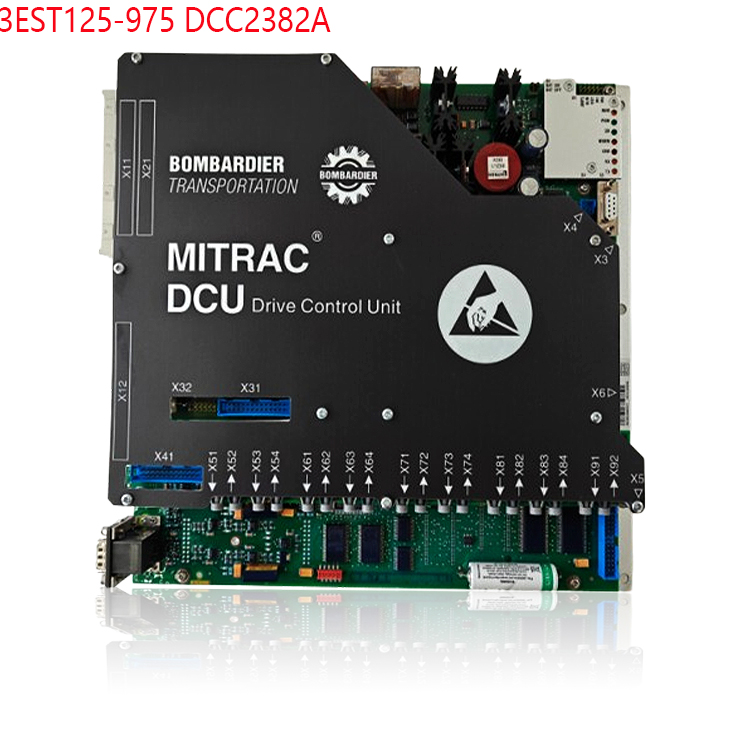
DCC2223A 3EST125-977 Drive Control Unit Technical Characteristics:
Processor Architecture: Dual-core PowerPC 750 @400MHz (lockstep redundancy), supports instruction output consistency verification, error rate <10⁻⁹/hour.
Communication Interface: 2×MVB Class 4 (EMD interface) + 1×RS485 maintenance port, compatible with TCN (Train Communication Network) standard, supports mixed scheduling of process data and message data. Storage and Power Supply: 1GB SDRAM + 512MB Flash, 24VDC input (16-36V range), typical power consumption 18W, built-in FRAM memory recording 100,000 fault events (including timestamps and environmental parameters).
Environmental Adaptability: Operating temperature -40°C to +85°C (compliant with EN 50155 CL2), IP67 protection rating, vibration resistance standard IEC 61373 Cat.1 Class B (5-250Hz random vibration), 50g shock resistant design.
Safety Mechanisms:
Dual-channel processor redundancy + hardware watchdog, automatically switching to a safe state in case of failure; self-test covering 95% of the circuit (including RAM/ROM/ADC verification), generating a diagnostic report upon startup.
Supports SIL 2 safety certification, suitable for automated operation scenarios in driverless subways (GoA4 level).
Performance Highlights:
Utilizes a high-performance microprocessor (e.g., DSP/ARM architecture) to support complex algorithms and high-speed data processing, enabling precise motor control (e.g., PID regulation, pulse triggering).
Modular design supports functional expansion, such as adding Profibus modules and remote I/O modules, adapting to different industrial scenarios.
Supports redundant configurations (e.g., dual power supplies, dual processors) to improve system reliability; supports hot-swapping to reduce downtime.
DCC2223A 3EST125-977 Drive Control Unit Application Scenarios:
Industrial Automation:
In industries such as steel, papermaking, and non-ferrous metal processing, it is used for strip tension control, rolling mill tension adjustment, etc., in conjunction with piezomagnetic sensors (e.g., PFTL101A series) to achieve high-precision force measurement.
Adapts to hydraulic systems and motor drive systems to achieve speed/torque control, dynamic braking, and fault diagnosis.
Power and Energy:
In generator excitation systems, it maintains voltage stability by adjusting the excitation current, supporting strong excitation multiple settings (e.g., ≥2 times for steam turbine generators).
Applications include: Wind power and photovoltaic grid connection control, enhancing grid flexibility; soft start and power failure transition functions in pumped storage power stations.
Rail Vehicle Control:
Metro/Light Rail: In driverless metro systems, coordinating traction/braking curve calculations and linking doors and signal platform screen doors ensures collision risk prediction and safe braking in mixed right-of-way sections.
High-Speed Trains: Reducing energy consumption by 15% through dynamic adjustment of multi-car power distribution (regenerative braking priority); eliminating the risk of circuit board condensation in cold regions (-40°C cold start) with anti-condensation coatings.
Trams: Utilizing the SIL 2 safety architecture, forcibly switching to safe braking mode in mixed right-of-way sections.
Digital and Intelligent Commissioning Applications:
CRRC Tangshan Locomotive & Rolling Stock Co., Ltd. adopts a digital and intelligent commissioning platform, acquiring control data from the DCC2223A 3EST125-977 via the MVB bus, and combining it with the Modbus TCP protocol to automate test procedures and perform data correlation analysis, improving commissioning efficiency and quality.
Used for traction command processing (such as torque management and braking curve calculation), coordinating the traction converter, braking control unit, and onboard signaling system, supporting the automatic operation of driverless subways (GoA4 level).
Other Scenarios:
Industrial scenarios requiring precise control and monitoring, such as robot control, automated production lines, and energy management systems.
DCC2223A 3EST125-977 Drive Control Unit Maintenance and Debugging Points
Daily Maintenance:
Regularly check the performance of electronic components (such as electrolytic capacitors and potentiometers), and it is recommended to replace vulnerable parts every 3-5 years; calibrate sensor output signals to ensure measurement accuracy.
Perform insulation tests and dielectric tests, and check the reliability of the grounding system and cable connections; clean the heat dissipation system to prevent dust accumulation and overheating.
Debugging Process:
Initial debugging requires calibrating the MVB bus communication parameters and verifying the signal transmission stability within a 20ms control cycle; use a dedicated test bench (such as MTT-1500) to simulate the MVB network protocol and test the real-time performance of traction commands.
Configure network parameters in the DCS system (e.g., IP address 10.221.9.47) to ensure smooth communication with HMI, PLC, and other devices.
Fault Diagnosis:
Quickly locate problems using fault codes (e.g., 34316, 34261), and troubleshoot using methods such as voltage signal measurement, IGBT/brake resistor testing, and checking for loose control lines.
Use the replacement method to verify component status, such as replacing suspected damaged modules or cables to confirm the root cause of the fault.
Safe Operation of the DCC2223A 3EST125-977 Drive Control Unit:
Installation and maintenance must be performed by a professional electrician. Ensure the system is properly grounded; after disconnecting the power, wait at least 5 minutes for the capacitors to discharge completely before operating.
Avoid operating control cables while the power is on to prevent high-voltage hazards; use a multimeter to confirm there is no voltage before performing maintenance.
In summary, the DCC2223A 3EST125-977 , as a core component of Bombardier’s industrial automation solutions, is widely used in power, metallurgy, chemical, and other industries due to its high-precision control, strong anti-interference capabilities, modular design, and remote maintenance capabilities. Users are advised to purchase through official channels and follow professional maintenance standards to ensure long-term stable system operation.
All products on this website are special products, and market prices are constantly fluctuating.
Please refer to customer service for a quote, as the price is not accurate for new products.
Please confirm the model, product, price, and other detailed information with customer service before placing an order. This website is currently in use.
New products are available for sale; please contact customer service for further information.
Recommended related products:
3EST125-975 DCC2382A
DCC2382A 3EST125-975
PFSK165
PFSK165 3BSE027778R1
PFSK110
PFSK110 57310001-HG
PFSK108
PFSK108 YM322001-EH
PFSK106 YM322001-EC
PFSK111
PFSK111 5735175-C
PPD517A3011 3BHE041576R3011
PPD517A3011
PPD517 ABB
PPD517 3BHE041576R3011
PPD512A10-454000 3BHE040375R103E
3BHE040375R103E PPD115
PPD512A10-454000 |
PPD539A102 3BHE039770R0102
PPD539A102
More……

Reviews
There are no reviews yet.