
Description
Many products have not yet been listed online; please contact us for more information.
If there is a discrepancy between the product model and the displayed image, the model number takes precedence. Please contact us for specific product photos; we can arrange for warehouse staff to take and provide confirmation images.
We operate 76 shared warehouses globally; consequently, it may sometimes take a few hours to provide you with an accurate response. We appreciate your understanding. Rest assured, we will address your inquiries as quickly as possible.
Product Overview
The IS420ESWBH3AE is an unmanaged industrial IONet Ethernet switch designed specifically for GE (General Electric) Mark VIe and Mark VIeS control systems. Part of the ESWB series of IONet switching modules, it is engineered for real-time control networks in critical units such as gas and steam turbines. It handles IONet industrial Ethernet data forwarding between controllers and I/O modules, serving as a core network component of GE turbine control systems. This model features sixteen 10/100Base-TX RJ45 copper ports (with no fiber-optic ports) and supports both DIN-rail and panel mounting, making it suitable for the harsh operating conditions found in industrial cabinets.
Operating Principle
The IS420ESWBH3AE utilizes a store-and-forward Ethernet switching architecture based on standard IEEE 802.3 and IEEE 802.3u Ethernet protocols, optimized specifically for IONet real-time control networks.
MAC Address Learning: It features a built-in 4K MAC address table that automatically learns the MAC addresses of control nodes within the IONet network. It establishes port-to-address mappings to forward data packets directionally, thereby suppressing unnecessary broadcast traffic and preventing broadcast storms from consuming control network bandwidth. Packet Buffering and Forwarding: Equipped with a 256KB data buffer, the switch queues and buffers multicast and broadcast packets—forwarding them frame-by-frame—when control messages flood multiple ports simultaneously. This prevents packet collisions and loss, ensuring stable timing for real-time control data transmission; independent packet buffering per port enhances concurrent communication capabilities.
Port Auto-Negotiation: All RJ45 ports support 10/100Mbps auto-sensing, full/half-duplex auto-negotiation, and HP-MDIX automatic cable detection. This eliminates the need to distinguish between straight-through and crossover cables and allows for automatic parameter matching with downstream Mark VIe controllers and I/O modules.
Redundant Power Supply (Diode-OR Circuit): Features dual 24/28VDC power inputs isolated by diodes. In the event of a single power supply failure, the system switches seamlessly to the other without interrupting IONet communication, ensuring the continuous operation of the unit’s control network.
Hardware-Based Status Monitoring via LEDs: Each port is equipped with indicators for link status, communication activity, and speed/duplex mode, while the unit itself features a power indicator. This provides real-time visual monitoring of network link status at the hardware level, allowing for quick diagnosis of port connectivity and communication status without requiring software login.
Important Note: This module is an unmanaged switch; it lacks a web-based management interface and does not support configurable network policies such as VLANs or static routing. It comes with factory-hardcoded forwarding logic specifically for the Mark VIe IONet and cannot be used as a standard IT switch.
Product Advantages
Real-Time Network Design for Turbine Control: Deeply optimized for the Mark VIe IONet control network, the switch offers low forwarding latency and prioritizes the transmission of deterministic real-time packets—such as those for unit protection and servo control. Unlike standard commercial switches, it eliminates control message jitter, meeting the safety control requirements for critical power plant units. Wide-temperature, high-reliability industrial hardware: Operates within a temperature range of -40°C to +70°C and humidity of 5%–95% (non-condensing); resistant to vibration and shock; withstands the high-temperature, dusty, and electromagnetically noisy environments of power plant cabinets; and supports long-term, continuous operation.
Redundant power architecture: Features dual 24/28VDC redundant power inputs; the failure of a single power circuit does not disrupt system operation, thereby reducing the risk of downtime due to single-point failure and aligning with the high-availability design philosophy of generator units.
Simple, configuration-free operation with low maintenance requirements: Unmanaged design allows for immediate operation upon power-up without the need for network commissioning; supports auto-negotiation and automatic cable polarity/crossover detection, enabling field replacement of spare parts without complex parameter configuration.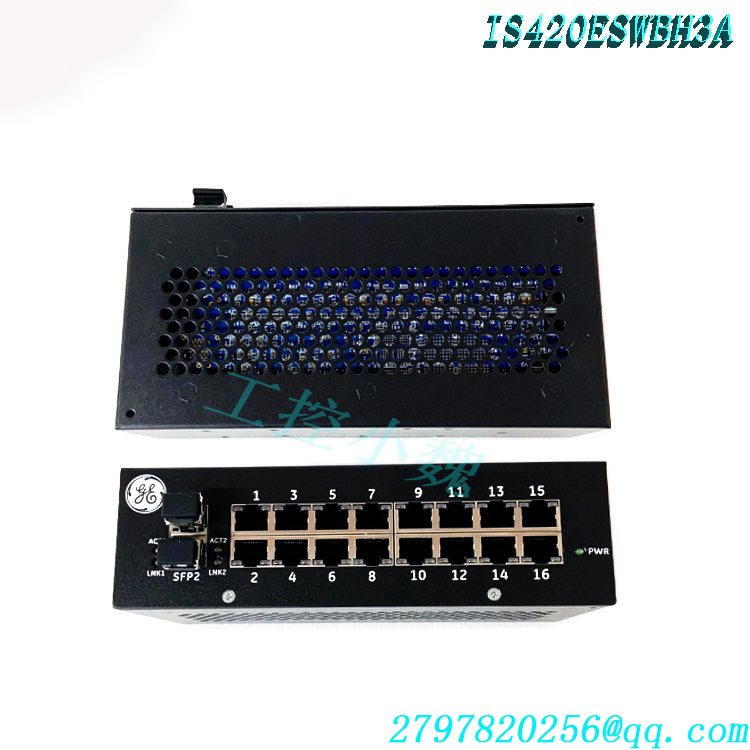
Comprehensive hardware status indicators: Port LEDs provide intuitive status displays for link, speed, and data transmission/reception, facilitating rapid fault localization and reducing downtime spent on troubleshooting.
Flexible installation options: Supports DIN-rail mounting as well as direct screw-based panel mounting, accommodating various cabinet layout retrofit projects. Applicable Industries and System Functions
Applicable Industries
Thermal/Gas-Fired Power Generation: Combined-cycle power plants (gas and steam turbines) using the Mark VIe control system
Petrochemicals: Captive power plants; compressor drive turbine units
Oil & Gas Extraction: Gas turbine-driven generator sets
Large-scale industrial power stations and cogeneration (CHP) projects
Functions within the Control System
IONet Core Data Exchange Hub: Serves as the core of the Mark VIe system’s internal I/O network, enabling high-speed, bidirectional, real-time data exchange between main controllers, remote I/O modules, and protection modules; transmits critical control and protection data such as unit speed, temperature, pressure, valve commands, and protection trip signals.
Control Network Traffic Isolation: Uses MAC address-based forwarding to limit the spread of broadcast storms and prevent localized network anomalies from propagating to the entire unit control system, thereby safeguarding the unit’s safety logic.
Control Network Node Expansion: Provides 16 RJ45 ports to expand the number of connected Mark VIe system I/O racks, enabling distributed I/O networking to meet the requirements for multi-point signal acquisition and output in large turbine units.
Ensuring Unit Protection Loop Continuity: Features a redundant power supply design that maintains IONet connectivity during single-point power distribution failures within the cabinet, ensuring the reliable transmission of emergency protection signals and reducing the risk of unplanned shutdowns.Operating Procedures
1. Pre-installation Preparation
① Perform work with power disconnected and wear an anti-static wrist strap to prevent electrostatic discharge (ESD) from damaging circuit board chips; ② Verify the model number (IS420ESWBH3AE) and inspect the module for physical damage or deformed connectors; ③ Confirm that the cabinet’s ambient temperature and humidity meet specifications and check the integrity of the grounding system; ④ Prepare compliant shielded twisted-pair (STP Cat5e) cable, ensuring the length of any single cable segment does not exceed 100 meters.
2. Hardware Installation
① DIN Rail Mounting: Attach the optional GE-supplied mounting clip to the switch housing, snap it onto the cabinet’s DIN rail, and lock it in place; Panel Mounting: Secure the module to the cabinet backplane using mounting screws; ② Power Wiring: Connect two 24/28 VDC power sources to power terminals TB1 and TB2 respectively, observing correct polarity; ③ Network Cable Connection: Connect the RJ45 ports to the Mark VIe controller and the I/O rack IONet port respectively; ensure the shield of the shielded network cable is reliably grounded at one end only to prevent ground loops.
3. Power-up and Status Check
① Power on the unit after verifying all wiring connections; ② Observe the power LED; a steady light indicates normal power supply; ③ Check individual port LEDs: a steady link light indicates a normal physical connection, while a flashing light indicates data transmission/reception; green indicates 100 Mbps, and yellow indicates 10 Mbps; ④ Use the ControlST software on the system side to scan the Mark VIe system and confirm that all IONet nodes are communicating correctly with no network alarms.4. Spare Part Replacement Procedure
① Disconnect both power supply lines to the module under conditions safe for the unit; ② Record the port numbers corresponding to the existing network cables, then disconnect the network cables and power terminals; ③ Remove the old module and install the new IS420ESWBH3AE; ④ Reconnect the network cables and power wiring according to the recorded configuration; ⑤ Power up the unit, verify the port LEDs, and use ControlST to validate IONet network communication.
Precautions
Electrostatic Protection: The module contains components sensitive to static electricity. An anti-static wrist strap must be worn throughout handling, removal, and installation; do not touch the circuit board’s metal contacts directly, and use anti-static packaging for storage.
Prohibition of Standard Switches: The IS420ESWBH3AE is a dedicated switch for the Mark VIe IONet and cannot be replaced by standard commercial switches. Standard switches cannot meet IONet real-time control timing requirements, which could lead to abnormal unit control or spurious protection trips.
Grounding Specifications: The shield of the shielded twisted-pair cable must be grounded at a single point only; grounding at both ends is strictly prohibited to prevent ground loops from introducing interference, which could cause intermittent packet loss or sporadic communication failures.
Power Supply Requirements: A 24/28VDC industrial power supply must be used; connection to AC mains power is prohibited. Dual independent redundant power supplies are recommended to enhance system fault tolerance.
Cable Limitations: Use Cat5e shielded twisted-pair cable with a maximum length of ≤100 meters per cable. To minimize electromagnetic interference, do not route network cables in close proximity to and parallel with power cables.
Environmental Limitations: Avoid installation in areas with corrosive gases, excessive dust, or strong vibrations. Ensure natural convection cooling by maintaining adequate ventilation space around the switch; do not enclose or seal the unit. Do not open the module for repair: There are no user-serviceable parts inside the module; do not disassemble the casing. Opening the casing voids the warranty and poses a risk of hardware damage. Faulty modules must be replaced as complete units.
Maintenance safety: Do not connect or disconnect IONet cables while the unit is operating. Such operations must be performed only when the unit is shut down or the system is in a permitted offline maintenance mode to prevent triggering a protective trip.
Spare parts storage: Store spare parts in an environment with a temperature range of -40°C to +85°C and no condensation; keep them sealed in anti-static packaging.
Related product recommendations:
IS420UCSCH1A-B
IS420UCSCH1A-F-VO.1-A
IS420YAICS1B
IS420UCSBH4A
IS420UCSBH1A
IS420UCSCS2A-B-V0.1-A
IS420PVIBH1B
IS420ESWBH4A
IS420ESWBH5A
IS420ESWAH5A
IS420UCSCH1B
IS220YDIAS1A
IS200AEPAH1BKE
IS200TDBSH2ACC
IS220PRTDH1A
IS220PSCAH1A
IS220PVIBH1A
IS200JPDEG1A
IS200VPROH1BEF
IS200VPROH2B
More……

admin –
System Role
Consistent with other members of the ESWB family, the H3AE serves as the backbone switch for the IONet real-time control network within the Mark VIe control architecture:
Connects controllers (such as UCSB, UCSC, UCDH, etc.) with distributed I/O modules to establish IONet network segments within and between cabinets;
Transports real-time protocols such as EGD (Ethernet Global Data), ensuring high-speed, deterministic data exchange for the turbine control system;
Supports a dual-IONet redundancy (Network A/B) architecture, enabling control communication redundancy through a dual-switch deployment;
Features an engineering design optimized for high-frequency IONet UDP multicast traffic, preventing frame collisions and packet loss—issues often encountered with general-purpose switches during transient unit operating conditions. Hardware and Electrical Specifications
Port Configuration: 16 x 10/100Base-TX copper RJ-45 ports (this model has no fiber-optic ports); ports feature individual LED indicators (link status, activity, duplex mode, speed);
Power Supply: Dual redundant DC power inputs; rated 24/28 VDC, max. approx. 1 A; operating range 18–36 VDC (per ESW series manual); dual power supplies provide mutual backup, ensuring uninterrupted operation during a single-circuit power failure;
Construction: Metal housing, DIN-rail mounting, natural convection cooling; hot-swappable (subject to GE operating procedures); circuit boards feature triple-layer conformal coating for harsh industrial environments;
Environmental: Operating temperature -40°C to +70°C; humidity 5% to 95% (non-condensing);
Hazardous Area Rating: Complies with Class 1 Div 2 / Zone 2 / ATEX requirements for hazardous locations (suitable for explosion-proof zones in power plants);
Dimensions and Weight: Approx. 188 × 86 × 56 mm (note: some documentation lists 138 × 86 × 56 mm; the nameplate and manual take precedence); weight approx. 0.9 kg.
admin –
Environmental Limitations: Avoid installation in areas with corrosive gases, excessive dust, or strong vibrations. Ensure natural convection cooling by maintaining adequate ventilation space around the switch; do not enclose or seal the unit. Do not open the module for repair: There are no user-serviceable parts inside the module; do not disassemble the casing. Opening the casing voids the warranty and poses a risk of hardware damage. Faulty modules must be replaced as complete units.