
Description
All products on this site are specialized items subject to fluctuating market prices.
Please refer to the quote provided by customer service for the actual price, as the listed price is not definitive.
Before placing an order, please confirm details such as the model, product specifications, and pricing with customer service.
New units are available for sale; please contact customer service for further information.
GFD563A102 3BHE046836R0102 – Alternative names:
LCI Converter Interface Controller GFD563A102 3BHE046836R0102
GFD563A102 3BHE046836R0102 Dual-Core Processing Unit
Excitation Central Processing Unit GFD563A102 3BHE046836R0102
Product Overview
The ABB GFD563A102 3BHE046836R0102 is an excitation controller module within the AC 800PEC high-performance power electronics control platform and is compatible with the ABB System 800xA automation system. This module is a high-speed, real-time control hardware unit developed for the excitation regulation of synchronous generators. Leveraging the microsecond-level processing capabilities of the AC800PEC, it performs signal acquisition, closed-loop excitation regulation, trigger pulse output, and online fault diagnosis. It serves as the core control component of the generator excitation system and can also function as a high-speed pulse I/O unit for controlling high-power power electronic devices.
Operating Principle
The GFD563A102 (3BHE046836R0102) excitation controller employs a closed-loop negative feedback regulation mechanism to control the excitation of synchronous generators. The overall control process comprises four key stages: signal acquisition, algorithmic computation, pulse output, and closed-loop correction.
Real-time Signal Acquisition: The module acquires analog and digital signals—such as generator terminal voltage, stator current, rotor excitation current, unit speed, and reactive power. It filters, conditions, and performs analog-to-digital conversion on raw sensor signals, eliminating noise caused by electromagnetic interference in the field environment.
Control Algorithm Computation: The module incorporates dedicated excitation control algorithms, including PID regulators and Power System Stabilizers (PSS). It compares voltage and reactive power setpoints against actual field feedback values to rapidly calculate the required excitation adjustment. Leveraging the AC800PEC platform’s parallel FPGA and processor architecture, the control cycle is as fast as 100μs, enabling rapid response to grid disturbances.
Pulse Drive Output: Computation results are converted into trigger pulses for the thyristor rectifier bridge and transmitted to the excitation power unit. By adjusting the thyristor firing angle, the module regulates the DC excitation current flowing through the rotor windings.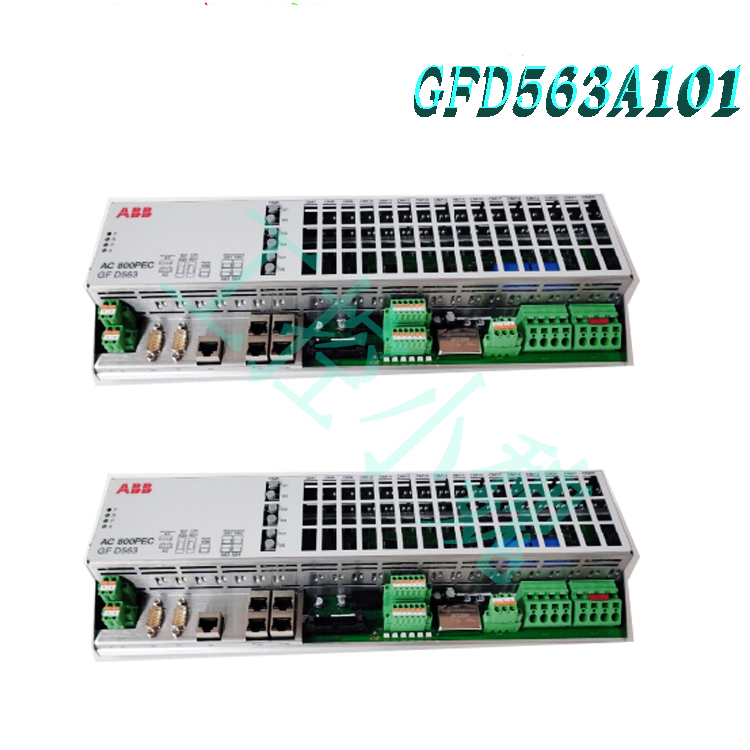
Continuous Closed-loop Correction: The module continuously monitors changes in generator voltage and reactive power output, dynamically adjusting the excitation output. In the event of grid fluctuations or sudden load changes, it automatically and rapidly adjusts the excitation current to stabilize terminal voltage, manage reactive power output, and suppress low-frequency power system oscillations. Built-in fault detection logic automatically triggers limiting, alarms, or protective tripping actions upon detecting abnormal conditions such as overcurrent, overheating, or loss of excitation. The module communicates with the AC800PEC controller backplane via high-speed fiber-optic links; fiber-optic transmission ensures isolation between high-voltage and low-voltage circuits, effectively avoiding electromagnetic interference from high-voltage sources. It also supports redundant architecture configurations, enabling bumpless switchover within milliseconds in the event of a fault.
Core Product Advantages
High-speed, real-time control at the microsecond level: The AC800PEC platform offers a minimum control cycle of 100μs. With a response speed superior to traditional excitation controllers, it rapidly suppresses grid disturbances and enhances the transient stability of the power system, making it suitable for large-capacity generator units and complex grid operating conditions.
Strong system compatibility and model-based development: It features native integration with the ABB System 800xA platform, supports IEC 61131-3 standard programming languages, and is compatible with Control Builder engineering software. It also supports MATLAB/Simulink model development, allowing simulation models to be deployed directly to the hardware, which significantly shortens project development and on-site commissioning cycles.
Excellent anti-interference and redundancy capabilities: Fiber-optic communication between modules isolates electromagnetic interference between high- and low-voltage circuits. It supports dual-controller redundant hot-standby configurations, enabling bumpless switchover within milliseconds during faults to ensure uninterrupted excitation system operation and meet reliability requirements for critical power plant loads.
Comprehensive protection and hardware self-diagnosis: Integrated protection logic covers over-excitation, under-excitation, over-current, over-temperature, loss-of-field, and pulse anomalies. Hardware self-diagnosis functions monitor module operating status in real-time and transmit fault codes to the SCADA system, allowing O&M personnel to quickly locate faults and reduce unit downtime for maintenance.
Modular architecture for convenient O&M: It utilizes a standard rack-mounted backplane structure, with supporting I/O sub-modules that allow for hot-swapping. Analog and digital I/O channels can be flexibly expanded based on generator unit capacity, eliminating the need to replace the entire excitation control system.Hardware Design for Wide Operating Conditions: Designed for a wide temperature range, the hardware operates stably within the complex temperature and humidity environments of power plant control cabinets. It supports continuous operation without forced air cooling, thereby reducing the risk of downtime caused by cooling system failures.
Applicable Industries and Functions
1. Thermal Power Generation
Serves as the core excitation control unit for steam turbine-generator sets; stabilizes generator terminal voltage, regulates reactive power output, and suppresses low-frequency oscillations in the power system. It provides strong excitation support during grid faults, enhances grid-connection stability, and ensures reliable power transmission from major thermal power sources.
2. Hydropower, Gas-Fired Power, and Distributed Energy Plants
Meets excitation regulation requirements for hydro-generators and gas turbine generators. It rapidly adjusts excitation during scenarios such as rapid load fluctuations in hydropower plants or frequent start-stop cycles in gas-fired units, ensuring smooth transitions between isolated grid operation and grid-connected modes, and supporting the stable integration of distributed power plants into the grid.
3. Petrochemical and Large-Scale Metallurgical Captive Power Plants
Controls excitation for industrial captive synchronous generator sets; stabilizes internal plant grid voltage to prevent unexpected shutdowns of continuous production facilities—such as refining and steel rolling units—caused by grid fluctuations, thereby minimizing economic losses.
4. Marine Power Systems and Rail Transit Traction Power Supplies
Used for excitation regulation of high-power synchronous generators and control of high-power power electronic converters, ensuring stable power quality for marine power stations and traction power supply systems.
5. Peak-Shaving Power Plants Supporting New Energy
Controls excitation for peak-shaving generator sets; coordinates with the fluctuating output of wind and solar power by rapidly adjusting reactive power, facilitating the integration of new energy sources and improving voltage levels in regional power grids.Operating Procedures
Important Note: Hardware installation, power-up, and commissioning must be performed by engineers qualified in power excitation systems, in strict accordance with ABB’s original technical manuals and the power plant’s safety operating procedures.
Hardware Installation: Insert the GFD563A102 (3BHE046836R0102) module steadily into the backplane of the AC800PEC standard rack and tighten the module’s mounting screws. Connect the fiber-optic communication links, ensuring the fiber end-faces remain clean. Separate low-voltage signal circuits from power trigger circuits; use shielded cables for sensor connections and ensure reliable grounding of the cabinet system.
Engineering Configuration and Program Download: Open the ABB Control Builder software to create a new project and configure hardware channel parameters, excitation control parameters, and protection settings. Complete the control logic and PSS parameter tuning. Download the project program to the AC800PEC controller via Ethernet, then verify that there are no compilation errors and that the hardware is correctly recognized.
Pre-power-up Checks: Verify all wiring while the system is de-energized, ensuring there are no short circuits or loose connections in the high- and low-voltage circuits. Check the integrity of fiber-optic links and ensure grounding resistance meets standards. Confirm that all protection settings strictly adhere to the unit’s setting specifications.
Step-by-Step Power-up and Commissioning: Step 1: Apply control power to the module; observe the RUN and FAULT indicators on the panel to confirm there are no hardware alarms. Read hardware self-diagnostic information via the supervisory computer and verify that all acquired signal values are normal. Step 2: No-load excitation test. Maintain the generator at rated speed, activate excitation, and slowly increase voltage; monitor the terminal voltage to ensure it tracks the setpoint smoothly and verify regulation accuracy. Step 3: Load test. Gradually increase the unit load, switch between voltage regulation and reactive power regulation modes, test step response and PSS suppression effectiveness, and fine-tune PID parameters until the system is stable. Step 4: Fault simulation testing. Verify the reliable operation of protection logic—such as over-excitation and loss-of-field protection—and ensure alarm signals are correctly transmitted to the 800xA supervisory system.
Normal Operation and Parameter Backup: Once the unit is grid-connected and operating normally, monitor excitation data in real-time via the 800xA interface. Perform full backups of project files and firmware images before any parameter modifications or firmware upgrades, and periodically export and archive operation logs.
Shutdown and Module Replacement: Disconnect the unit from the grid and deactivate the excitation system. Isolate the module’s power supply and verify the absence of residual voltage before removal. After installing a replacement module, re-download the project configuration and repeat the no-load verification procedure.
Precautions
Electrostatic Protection: Module circuit boards and fiber-optic interfaces are sensitive to static electricity. Personnel must wear grounded anti-static wrist straps during installation or removal; direct contact with circuit board components or backplane gold fingers using bare hands is strictly prohibited.
Fiber-Optic Handling: Keep fiber-optic end-faces clean and ensure the bending radius does not fall below the manufacturer’s specified minimum. Prevent dust contamination on end-faces during connection or disconnection to avoid communication packet loss or control interruptions.
Prohibition of Live Insertion/Removal: Hot-swapping (live insertion or removal) of modules or backplane communication circuits is strictly prohibited. Power must be completely disconnected and verified as off before handling to prevent damage to the backplane or module chips.
Environmental Control: Implement dust and moisture protection for control cabinets and maintain the operating temperature within the product’s rated range. Regularly clean cabinet filters to prevent dust accumulation, which could impair module heat dissipation and trigger over-temperature protection.
Parameter Modification Control: Excitation PID, PSS, and protection settings are critical to the safety of the generator unit and the power grid. All parameter modifications require technical approval and must be fully documented; arbitrary online modification of critical parameters is strictly prohibited. Grounding Specifications: Signal-shielded cables must be grounded at one end only; cabinet protective grounding must be routed independently, with grounding resistance meeting electric power industry standards. High-voltage and low-voltage (signal) grounding systems must be kept separate to prevent signal drift caused by ground potential interference.
Spare Parts and Firmware Management: Verify hardware version numbers when replacing modules; perform a full project backup before upgrading firmware and conduct no-load verification afterward; avoid skipping firmware versions during upgrades without prior assessment.
Safety Isolation: Ensure high-voltage circuits are isolated during the commissioning phase and strictly adhere to the work permit system; as the excitation power unit is part of the high-voltage circuit, safety warning signs must be posted at the commissioning site to prevent electric shock accidents.
Routine Inspections: Focus routine inspections on module indicator lights, communication status, temperature, and alarm logs; in the event of a “FAULT” alarm, prioritize reducing the unit load or disconnecting the unit from the grid to investigate the root cause—long-term operation with unresolved faults is prohibited.
Recommended popular module models:
3BHE046836R0101
GFD563A101 3BHE046836R0101
3BHE046836R0102
GFD563A102 3BHE046836R0102
GFD563A101 3BHE046836R010
3BHE046836R010
PC D232 A|PEC80-CIO|3BHE022293R0101
PDD24
PCD2000
GFD563A101
8R37-2021-21-3101 PCD2000
GFD563A102
GFD563A102 3BHE046836R0102
PC D232 A|PEC80-CIO|3BHE022293R0101|PCD232
UAD149A0011 3BHE014135R0011
more……
admin –
All products on this website are special products and market prices have been fluctuating. Please refer to the customer service quotation for details. As the products are new and the traps are not real, please confirm the model, product, price, and other detailed information with customer service before placing an order. The website has been used and the new ones are for sale. Please contact Industrial Control Sales Consultant: Carrey for communication.
admin –
ABB GFD563A102 | 3BHE046836R0102 | GF D563 A102, AC 800PEC controllers are suitable for industries such as industrial automation and machinery, utilities and energy, process control and monitoring. The AC 800PEC toolbox is required to access the controller hardware. Using Simulink external mode can achieve user-friendly monitoring. If an AC 800PEC controller is required, it can be programmed using ABB’s Control Builder M programming tool (compliant with IEC 61131-3), as well as MATLAB, Simulink, and Simulink Coder.
admin –
The AC 800PEC controller can be programmed using Simulink and Simulink Coder. The AC 800PEC toolbox is required to access the controller hardware. Using Simulink external mode can achieve user-friendly monitoring.
To use the AC 800PEC controller in Compact Control Builder 5.1, you can refer to the manual or documentation related to the configuration of the AC 800PEC controller.
admin –
Address: Building A, Wanda Center, No. 175 Jiefang Road, Xinghualing District, Taiyuan City, Shanxi Province
Email: wkcarshop666888@gmail.com
Industrial Control Sales Consultant: Amelia
WhatsApp:+86 18030295882
Official website: https://www.axcontroler.com/
Greetings and gratitude
angel –
ABB gfd563a102 | 3bhe0466836r0102 | GF d563 a102, el controlador AC 800pec es adecuado para industrias como automatización industrial y maquinaria, servicios públicos y energía, así como control y monitoreo de procesos. El acceso al hardware del controlador requiere una caja de herramientas ac 800 pec. El uso del modo externo de simulink permite una supervisión fácil de usar. Si necesita usar el controlador AC 800pec, puede programarlo con la herramienta de programación control Builder m de ABB que cumple con IEC 61131 – 3, así como con los codificadores matlab, simulink y simulink. El acceso al hardware del controlador requiere una caja de herramientas ac 800pec. El uso del modo externo de simulink permite una supervisión fácil de usar. El controlador ABB gfd563a102 | 3be046836r0102 | GF d563 a102 AC 800pec es una herramienta poderosa para controlar los procesos de media y alta velocidad y baja velocidad en diversas industrias. Se puede programar con la herramienta de programación control Builder m de ABB que cumple con IEC 61131 – 3, así como con los codificadores matlab, simulink y simulink. El acceso al hardware del controlador requiere una caja de herramientas ac 800pec y se puede utilizar el modo externo de simulink para una supervisión fácil de usar.
Jamaal Wyrostek –
I’ve been surfing on-line greater than 3 hours today, but I never discovered any interesting article like yours. It’s pretty worth sufficient for me. In my view, if all website owners and bloggers made just right content as you probably did, the internet can be a lot more useful than ever before.
Freddie Ponder –
I have learn a few good stuff here. Definitely value bookmarking for revisiting. I wonder how much attempt you put to make this kind of wonderful informative web site.
admin –
ABB GFD563A102 | 3BHE046836R0102 | GF D563 A102, AC 800PEC controllers are suitable for industries such as industrial automation and machinery, utilities and energy, process control and monitoring. The AC 800PEC toolbox is required to access the controller hardware. Using Simulink external mode can achieve user-friendly monitoring. If an AC 800PEC controller is required, it can be programmed using ABB’s Control Builder M programming tool (compliant with IEC 61131-3), as well as MATLAB, Simulink, and Simulink Coder. The AC 800PEC toolbox is required to access the controller hardware. Using Simulink external mode can achieve user-friendly monitoring. ABB GFD563A102 | 3BHE046836R0102 | GF D563 A102 AC 800PEC controller is a powerful tool for controlling high-speed and low-speed processes in various industries. It can be programmed using ABB’s Control Builder M programming tool (compliant with IEC 61131-3), as well as MATLAB, Simulink, and Simulink Coder. You need to use the AC 800PEC toolbox to access the controller hardware and can use Simulink external mode for user-friendly monitoring. ABB GF D563 | 3BHE046836R0101 | GFD563A101 | AC 800PEC. ABB AC 800PEC is a controller that combines high-speed control requirements for processes such as power electronics applications with low-speed process control tasks typically performed by separate PLC units. It uses ABB’s Control Builder M programming tool (compliant with IEC 61131-3), as well as MATLAB, Simulink, and Simulink Coder for configuration and programming. The AC 800PEC is connected to ABB’s I/O system through the optical S800 ModuleBus and to ABB’s communication module through the Communication Expansion Bus (CEX). It also supports third-party Anybus-S fieldbus modules.
admin –
The AC 800PEC controller can be programmed using Simulink and Simulink Coder. The AC 800PEC toolbox is required to access the controller hardware. Using Simulink external mode can achieve user-friendly monitoring.
To use the AC 800PEC controller in Compact Control Builder 5.1, you can refer to the manual or documentation related to the configuration of the AC 800PEC controller.
The AC 800PEC GFD563 controller can be used in industries such as industrial controllers and PLCs, control systems, digital signal processing, embedded systems, process control and monitoring, real-time systems, industrial automation and machinery, utilities and energy.
vorbelutr ioperbir –
I’ve been surfing online more than three hours today, yet I never found any interesting article like yours. It is pretty worth enough for me. Personally, if all website owners and bloggers made good content as you did, the net will be a lot more useful than ever before.
Charlie Hamelin –
Thank you for every other informative web site. Where else may just I am getting that type of info written in such a perfect way? I have a mission that I’m just now running on, and I have been at the look out for such information.
admin –
https://www.axcontroler.com/ABB/gfd563a101—excitation-central-processor-module—abb—3bhe046836r0101—gfd563a101
The 3BHE046836R0101 GFD563A101 excitation central processing unit module supports a variety of analog and digital input and output combinations, and can process multiple signals simultaneously. The specific input and output configuration may include digital input, analog input, digital output, and high-speed digital output, etc., to meet complex control requirements. At the same time, through additional expansion modules, the configuration of this module can be further expanded to adapt to more complex application requirements in the fields of industrial automation and robotics. The expansion modules can be installed locally or remotely, providing greater flexibility and convenience.
https://www.weikunfadacai1.com/product/abb-gfd563a102-3bhe046836r0102/
admin –
ABB 3BHE046836R0102 (sub-model GFD563A102) is one of the core controller modules of ABB AC 800PEC control system, which belongs to high-performance programmable logic controller (PLC). It is widely used in the field of industrial automation to control various types of industrial processes, especially in power generation, petrochemical, metallurgy, papermaking and other industries.
Technical specifications and functions
1. Core parameters
Model and series: GFD563A102, belongs to AC 800PEC series.
Function: As a programmable logic controller (PLC), it supports complex control algorithms and multiple control functions.
Interface: Equipped with a variety of industrial interfaces, compatible with industrial communication protocols such as Profibus DP and Modbus.
Working environment: Suitable for harsh industrial environments, with high reliability and stability.
Product specifications
Processing power: Adopts high-performance processors to support complex control algorithms and fast data processing.
Input and output:
Digital input: 30 (including 2 shaft encoder inputs).
Analog input: 2.
Digital output: 28.
High-speed digital output: 2.
Total: 62 analog and digital input and output combinations, expandable to 1024 I/O through expansion modules.
Communication capability: Supports multiple industrial communication protocols to achieve seamless interconnection with other devices.
Programming language: Supports IEC 61131-3 standard programming language, which is convenient for users to develop and debug programs.
admin –
3. Key functions
Logic control: Implement various logic control functions, such as sequence control, timing control, etc.
Process control: Accurately control various variables in industrial processes (such as temperature, pressure, flow, etc.).
Data acquisition and processing: Collect data from field equipment, process and analyze it to provide support for decision-making.
Human-machine interface integration: Can be used as part of the human-machine interface, providing operation and monitoring functions to facilitate user interaction with the system.
Application scenarios
1. Industrial automation
Petrochemical industry: In refineries and chemical plants, it is used to control various complex process flows to ensure safe and stable production.
Power industry: In power plants and substations, it is used to monitor, control and optimize power systems to improve energy efficiency.
Metallurgical industry: In steel plants and aluminum plants, it is used to control key equipment such as blast furnaces and rolling mills to ensure efficient production and product quality.
Papermaking industry: In pulp and paper mills, it is used to control the operation of paper machines to ensure paper quality and production efficiency.
Including upgrades to higher performance versions (such as GFD563A103).
https://www.weikunfadacai1.com/product/gfd563a101-ac-800pec-control-unit-abb-3bhe046836r0101-gfd563a101-gfd563/
https://www.weikunfadacai1.com/2025/04/07/gfd233a103-3bhe022294r0103-servo-controller-module-gfd233a103/
https://www.weikunfadacai1.com/product/gfd563a102-ac-800pec-control-unit-abb-3bhe046836r0102-gfd563a102/
https://www.weikunfadacai1.com/2024/05/16/abb-excitation-control-unit-module-gfd563a102-3bhe046836r0102/
https://www.weikunfadacai1.com/product/gfd233a101-3bhe022294r0101-gfd233a-abb-interface-module/
https://www.weikunfadacai1.com/product/3bhe022294r0101-3bhe022294r0101-gfd233a-abb-interface-module/
https://www.weikunfadacai1.com/product/gfd233a101-gfd233a101-gfd233a-abb-interface-module/
https://www.weikunfadacai1.com/product/abb-gfd563a101-3bhe046836r0101/
https://www.axcontroler.com/ABB/gfd563a101—excitation-central-processor-module—abb—3bhe046836r0101—gfd563a101
https://www.axcontroler.com/ABB/gfd563a101—excitation-central-processor-module—abb—3bhe046836r0101—gfd563a101
https://www.axcontroler.com/ABB/gfd563a102—excitation-central-processor-module—abb—3bhe046836r0102—gfd563a102
https://www.axcontroler.com/ABB/gfd233a101—3bhe022294r0101—analog-i-o-module—gfd233a101
https://www.axcontroler.com/ABB/gfd233a101—abb—analog-i-o-module—gfd233a101
https://www.axcontroler.com/ABB/gfd212a—3bhe020356r0101—analog-i-o-module—3bhe020357p201
https://www.axcontroler.com/ABB/gfd233a—abb—analog-i-o-module—gfd233a
https://www.axcontroler.com/ABB/gfd233a—3bhe022294r0103—analog-i-o-module—gfd233a
admin –
Model Naming Rules
Partial Meaning
GFD Product Series Prefix:
G: Generator
F: Field
D: Digital Control |
| 563 | Product model code, representing a specific design version (e.g., hardware architecture, interface type) |
| A102 | Version Number:
A: Major version (e.g., hardware platform)
102: Sub-version (e.g., firmware upgrade or hardware improvement) |
| 3BHE046836R0102 | ABB internal part number (part number), used for ordering, spare parts management, and production traceability |
https://www.weikunfadacai1.com/2024/05/16/abb-excitation-control-unit-module-gfd563a102-3bhe046836r0102/
https://www.weikunfadacai1.com/product/abb-gfd563a102-3bhe046836r0102/
admin –
Core Functional Positioning
Excitation Control Core
Serving as the “brain” of the generator excitation system, it achieves the following goals by regulating the excitation current:
Voltage Stability: Maintains the generator terminal voltage within ±1% of the rated value (e.g., ±0.5% for a 500kV system).
Reactive Power Management: Distributes reactive power according to grid dispatch instructions, supporting leading/lagging operation.
Dynamic Response: Suppresses voltage fluctuations caused by sudden load changes or faults (e.g., recovering to 90% of rated voltage within 0.1 seconds after a short circuit).
Protection and Safety
Overexcitation Limiting: Prevents rotor overheating (e.g., continuous operation at 1.1 times the rated excitation current for ≤ 2 minutes).
Underexcitation Limiting: Prevents generator loss of step or stator end overheating (e.g., leading depth ≤ 0.95 times the rated voltage).
De-excitation Protection: Detects an excitation fault and triggers rapid generator tripping (operation time ≤ 100ms).
Communication and Integration
Supports IEC 61850 (Substation Automation Standard) or Modbus TCP, seamlessly integrating with DCS/SCADA systems.
Redundant communication interfaces (such as dual Ethernet ports) are provided to ensure data reliability.
Key Technical Features
Control Algorithm
PID Regulation: Basic voltage control, eliminating steady-state errors through a proportional-integral-derivative (PI-D) algorithm.
PSS (Power System Stabilizer): Added damping control to suppress low-frequency oscillations of 0.1-2 Hz (such as common oscillation patterns in hydropower plants).
Adaptive Control: Automatically adjusts parameters (such as load factor and power factor) based on operating conditions.
Hardware Design
Dual CPU Redundancy: Active and standby controllers provide real-time hot standby, with seamless failover in the event of a failure (failure time <10ms).
High Isolation: Isolation voltage between input/output and power supply ≥2500V AC, providing strong anti-interference capabilities.
Wide operating temperature range: -20°C to +60°C, suitable for extreme climates (such as desert power plants or high-altitude cold regions).
Interface Configuration: Interface Type: Typical Signals
Analog Inputs: Generator voltage (100V AC on the PT secondary side), current (5A AC on the CT secondary side), excitation current (0-20mA DC)
Digital Inputs: Start/Stop Commands, Protection Action Signals, Manual/Auto Switch Status
Analog Outputs: Excitation Current Command (4-20mA), Voltage Regulation Signal (0-10V DC)
Digital Outputs: Alarm Signals, Trip Commands, and Synchronization Signals
admin –
Typical Application Scenarios
Thermal Power Plants
600MW Supercritical Units: Combined with the ABB UNITROL 6000 excitation system, achieves high-precision voltage regulation (error <0.3%).
Combined Cycle Power Plants: Rapidly respond to gas turbine load changes and support black start functionality.
Hydropower Plants
Pumped Storage Power Plants: Dynamically adjust excitation parameters to maintain voltage stability when switching between power generation and pumping modes.
High Head Units: Suppress voltage fluctuations caused by water hammer and protect generator insulation.
Renewable Energy
Wind Power with Energy Storage: Improve grid frequency stability by simulating inertial response through synchronous generators.
Photovoltaic Hydrogen Projects: Provide excitation control for synchronous generators powering electrolyzers to ensure stable hydrogen production.
Key Selection Points
Compatibility Verification
Confirm that the module is compatible with the existing excitation system model (e.g., UNITROL 5000/6000 series).
Check the signal interface type (e.g., whether the PT secondary voltage is 100V and the CT secondary current is 5A).
Performance Requirements
Dynamic Response Speed: Select based on grid requirements (e.g., recovery time for ±1% voltage fluctuation ≤ 50ms).
PSS Function: If the grid is at risk of low-frequency oscillation, select a module that supports the PSS2A/PSS2B standard.
Environmental Adaptability
Altitude: If the installation altitude is >2000m, derating is required (e.g., reducing the excitation current limit by 10%).
Protection Level: For outdoor installation, IP54 protection (with dust and water-resistant cover) is required.
Redundancy Configuration
For critical applications, dual-module hot standby is recommended, with fiber optic communication for bumpless switching.
Common Problems and Solutions
Problem Symptom: Possible Causes and Solutions
Large voltage fluctuations: PID parameter misalignment, loose PT/CT wiring. Recalibrate the sensor and adjust the PID parameters using ABB’s dedicated software (such as ExpertOptimizer).
Unable to adjust the excitation current: Power module fault, trigger pulse loss. Check the thyristor rectifier bridge status and replace the damaged module; verify the trigger pulse waveform (oscilloscope measurement).
Communication interruption: Damaged network cable/fiber, IP address conflict. Check the physical connection and configure a static IP address; update the firmware to fix communication protocol vulnerabilities.
Self-diagnostic alarm (E001): Power module overvoltage. Measure the input voltage (normal range: 220V ± 10%) and replace the power board.
Precautions
Safety measures: Disconnect the power supply before maintenance and display a “Do Not Close” sign. Use insulated tools.
Anti-static measures: Wear an anti-static wrist strap when replacing modules to avoid damage to electronic components.
Compliance: Ensure the module complies with local grid regulations (such as IEEE STD 421.5 and GB/T 7409.3).
admin –
GFD563A102 | ABB | GFD563A102 | 3BHE046836R0102 | GF D563 A102 | Excitation controller | 3BHE046836R0102 | GFD563
GFD563A102 | ABB Industrial Control Module Comprehensive Analysis
Technical Specifications and Core Features
Basic Parameters
Model: ABB GFD563A102 (serial number 3BHE046836R0102), a fiber optic communication module for the AC800M/Symphony Plus DCS platform, compatible with the AC800PEC system.
Communication Capabilities: Supports 100 Mbps full-duplex Ethernet communication, compatible with multimode (≤2 km) and single-mode fiber (10-40 km), supports SC/ST interfaces, features dual-port redundancy (can be used to build a ring network), and has a switching time of ≤20ms.
Physical Characteristics: Dimensions: 142mm × 73.5mm × 380mm, weight: 1.54kg, IP20 protection rating, operating temperature: -25°C to +60°C, DIN-rail mounting, vibration/shock resistant design.
Electrical Parameters: Input voltage 24V DC/110-240V AC, output 0-10V DC/0-20A, power consumption ≤5W, supports 50/60Hz operating frequency.
Expansion Capabilities
Expandable up to 1024 I/O points (via local/remote expansion modules, up to 1000m from the controller), supporting motion control, logic control, and data acquisition. Compatible with ABB S800 I/O modules and third-party devices (such as Siemens PLCs).
Core Functions and Application Scenarios
Core Functions
Long-Distance Communication: Suitable for power plants (connecting the main plant to remote water treatment plants), long-distance pipelines (pumping stations to control centers), and petrochemical plants (communication between different process units).
Excitation Control: As the core module of the UNITROL 6000 series static excitation system, it regulates the generator rotor excitation current to achieve voltage stability (fluctuation ≤±0.5%), optimize reactive power, and improve dynamic response.
Redundancy and Protection: Built-in overcurrent, overvoltage, and overtemperature protection, hot-swappable modules automatically switch to the backup module in the event of a fault, ensuring continuous system operation.
Application Scenarios
Power Industry: Substation automation, grid monitoring, and generator excitation control (hydropower, thermal power, and wind farms).
Industrial Control: Process control systems, SCADA systems, and PLC expansion modules (such as signal acquisition and output).
Special Applications: Rail transit (subway BAS systems), municipal engineering (pumping stations and dispatching centers), and petrochemical complexes (cracking/hydrogenation unit control).
Differences from GFD563A101
Technical Differences
The GFD563A102 may surpass the A101 in communication speed, transmission distance, and redundancy design (such as support for longer-distance single-mode fiber communication). Please refer to the technical documentation for details.
The A102 may integrate more advanced expansion capabilities (such as larger I/O capacity or more flexible configuration options), while the A101 focuses more on basic communication and control functions.
Compatibility
Both controllers are compatible with AC800M series main controllers (such as PM851 and PM861) and I/O modules, allowing for seamless system integration. However, hardware version and firmware compatibility must be carefully considered.
Maintenance and Support
Installation and Commissioning
Comply with DIN rail mounting specifications to ensure unobstructed heat dissipation and avoid sources of electromagnetic interference. Parameter configuration is performed using ABB Control Builder or Automation Builder, supporting IEC 61131-3 programming standards.
Maintenance Recommendations
Regularly inspect connector oxidation, capacitor aging, and cooling fan status. Perform firmware upgrades every two years to optimize algorithms. Unauthorized modifications may void the warranty.
Troubleshooting: Use LED indicators (such as RUN/ERR) to determine status. A solid red light indicates a hardware fault and requires contacting the supplier’s technical support.
Added Value and Advantages
Software Support: Compatible with ABB 800xA DCS systems and supports MATLAB/Simulink programming, enabling rapid deployment of complex control logic.
Protocol Compatibility: Supports industrial protocols such as OPC UA, Modbus TCP, and IEC 61850, adapting to data exchange with DCS/SCADA systems.
Certifications and Standards: Complies with international certifications such as CE and UL, meeting industrial automation safety regulations.
admin –
ABB GFD563A102 3BHE046836R0102 Excitation Control Unit Comprehensive Analysis (2025 Latest Version)
Core Positioning and Technical Features
System Affiliation: This system belongs to the ABB AC800PEC high-end control system, order number 3BHE046836R0102, and is the core module for generator excitation control and industrial automation. It utilizes a multi-core processor architecture (2.5GHz or PowerPC 405 200MHz) to support high-speed control (cycle time ≤ 100µs) integrated with low-speed process control, making it suitable for high-power rectifier scenarios.
Hardware Design:
Physical Parameters: Dimensions: 142mm × 73.5mm × 380mm, weight: approximately 1.54kg, protection rating: IP67/IP20/IP65, operating temperature: -20°C to +60°C, suitable for harsh industrial environments.
Electrical Parameters: Input voltage 85V AC to 264V AC (supports 24V DC), output voltage 0-400V AC or 5V-60V DC, output current 10A, power 100W. Equipped with 4GB DDR3 RAM/8GB eMMC storage, it supports 62 I/O channels (30 digital inputs + 28 digital outputs + 2 analog inputs + 2 high-speed outputs), expandable to 1024 I/O points.
Interfaces and Communications: Compatible with RS232/RS485, Ethernet, PROFINET DP, CAN, and other protocols, supporting Modbus/CANopen industrial standards. Built-in dual-port redundancy allows for ring network construction and HSR/PRP protocols.
Core Functions and Application Scenarios
Excitation Control: A closed-loop PID algorithm precisely regulates the generator rotor excitation current, maintaining terminal voltage stability (fluctuation ≤±0.5%), optimizing reactive power distribution, and improving the static and dynamic stability of the power system. It supports overvoltage, undervoltage, and overcurrent protection, as well as rapid de-excitation.
Industrial Automation: Widely used in power generation (thermal power/hydropower/wind farms), petrochemicals, metallurgy, rail transit, intelligent manufacturing, and other fields. Typical cases include:
Power Industry: Substation automation, dynamic reactive power compensation in HVDC converter stations, grid monitoring, and SCADA system integration.
Industrial Control: PLC expansion modules, process control systems, robotic control (such as machine tools and packaging machinery), and material handling systems.
Special Scenarios: Marine propulsion systems, grid-connected inverters for new energy vehicles, arc furnace power factor optimization, process optimization for municipal wastewater treatment plants, and automotive production line control.
Technical Advantages and Innovations
Redundancy and Self-Diagnostics: Supports dual-module redundant configuration with active/standby switchover time of ≤20ms, ensuring continuous system operation. Built-in fault code storage, real-time status monitoring, and remote diagnostic interfaces are compatible with SCADA systems.
Modular Expansion: Compatible with ABB S800 I/O modules and fiber-optic communication links, it supports functional expansion up to 1024 I/O points, reducing integration costs.
Software Support: Compatible with ABB Control Builder M, Automation Builder, and CODESYS platforms, it supports IEC 61131-3 programming standards and automatically generates control code, streamlining the development process.
Certifications and Standards: It complies with international certifications such as CE and UL, meets industrial automation safety standards (such as IEC 61508), and features a built-in STO (Safe Torque Off) function to ensure safe operation.
Installation and Maintenance Recommendations
Installation: Follow DIN rail mounting standards, ensure unobstructed heat dissipation, and avoid sources of electromagnetic interference (such as high-power motors). A separate overspeed protection device is required to comply with EMC standards (such as EN50082-2).
Maintenance Tips: Regularly inspect connector oxidation, capacitor aging, and cooling fan status. Perform firmware upgrades every two years to optimize algorithms. Unauthorized modifications may void the warranty. Troubleshooting: LED indicators (such as RUN/ERR) can quickly identify problems. A solid red light indicates a hardware failure and requires contacting the supplier’s technical support.
Compatibility Verification: Compatibility with the ABB AC800PEC backplane system, S800 I/O modules, and third-party devices (such as Siemens PLCs) must be verified to avoid configuration errors.
Differences from the GFD563A101
I/O Expansion Capacity: The A102 supports 62 I/O channels, expandable to 1024 I/O points; the A101’s I/O configuration may differ (specific model confirmation required).
Processor Performance: The A102 uses a multi-core processor (2.5GHz or PowerPC 405 200MHz), while the A101 may use a processor with a different architecture.
Communication Protocol Support: The A102 is compatible with more industrial protocols (such as PROFINET DP and CANopen), while the A101 may focus on Ethernet or specific protocols.
Application Scenario Adaptability: The A102 performs better in industrial automation and robotics (such as machine tool control and packaging machinery), while the A101 may be more focused on specific scenarios in the power industry.
Latest Technology Updates and Application Cases
Technical Innovation: The 2025 version supports compatibility with AC 800M series main modules (such as PM851 and PM861), integrating AI control technology to enable autonomous operation. For example, in the petrochemical industry, AI automatically adjusts process parameters, reducing manual intervention and improving production efficiency and safety.
Application Case: In the DCS system of the Baoding Petrochemical Thermal Power Plant, the GFD563A102 reduces failure rates and extends service life by optimizing the cooling system design (such as air channels cooling power components). In small thermal power plants, the integration of new coating technology protects PCBs from dust and oil, ensuring reliable operation in harsh environments.
zoritoler imol –
Good – I should certainly pronounce, impressed with your site. I had no trouble navigating through all the tabs as well as related information ended up being truly easy to do to access. I recently found what I hoped for before you know it in the least. Quite unusual. Is likely to appreciate it for those who add forums or anything, website theme . a tones way for your customer to communicate. Excellent task..
Kellye Boards –
Super-Duper site! I am loving it!! Will come back again. I am taking your feeds also
tlover tonet –
Hello There. I discovered your blog using msn. That is an extremely smartly written article. I will make sure to bookmark it and return to learn extra of your useful info. Thanks for the post. I’ll certainly comeback.
tlover tonet –
I just couldn’t depart your site before suggesting that I extremely enjoyed the standard information a person provide for your visitors? Is going to be back often to check up on new posts
zimerovertover –
I like this site very much so much wonderful info .
Makayla –
I saw one of these in Comoros and I bought one.
admin –
I. Basic Model Information
Model: GFD563A102
Material Code: 3BHE046836R0102
System Affiliation: AC800PEC High-Speed Power Electronics/Excitation Dedicated Control Platform (different from the general AC800M DCS)
Positioning: Dedicated main control drive module for synchronous generator excitation, compatible with UNITROL series static self-excitation excitation systems
II. Core Functions (Core of the Excitation System)
Excitation Closed-Loop Regulation and Control
Receives terminal voltage, stator current, and grid frequency signals from the PT/CT; incorporates a high-speed PID algorithm; outputs thyristor trigger pulses in real time to regulate rotor excitation current, stabilize generator terminal voltage, and control reactive power; adaptive regulation in both grid-connected and islanded modes, with a dynamic response ≤100ms.
Power Unit Drive Output
Drives the excitation rectifier bridge (thyristor/IGBT power cabinet), outputting isolated drive signals, suitable for the excitation power circuits of large and medium-sized steam turbines, hydro turbines, and gas synchronous generators.
Full-Circuit Signal Acquisition
Multi-channel isolated analog signal acquisition of excitation voltage, excitation current, temperature, and grid frequency; 12-bit high-precision analog-to-digital conversion, measurement accuracy ±0.2%.
Multiple Fault Protection and Diagnosis
Built-in overcurrent, overvoltage, underexcitation, overexcitation, loss of excitation, overtemperature, frequency anomaly, and power bridge fault detection; local LED status indicators, fault code storage, event logging, and support for remote diagnostics.
High-Speed Real-Time Calculation
Dedicated hardware for the AC800PEC platform, microsecond-level control cycle, meeting the rapid adjustment needs of power system transient stability, load shedding, short-circuit faults, and other extreme conditions.
Multi-protocol Industrial Communication
Onboard Ethernet and PROFIBUS DP connectivity enable integration with power plant SCADA and DCS backends to upload excitation operating parameters, fault alarms, and control curves; GSD files are included for rapid configuration.
III. Hardware and Electrical Specifications
Power Supply: DC24V backplane bus power supply, low-power industrial design
Signal Channels
Multi-channel isolated analog inputs: ±2.5V/±5V/0–10V/4–20mA standard signals
Isolated digital inputs/outputs, pulse-triggered outputs (excitation power bridge drive)
Environment
Standard cabinet operation: 0℃~+55℃; Wide-temperature models: -40℃~+70℃
High-voltage channel isolation, EMC electromagnetic interference resistant, suitable for strong electromagnetic environments in power plants
Installation: Standard DIN rail/rack backplane slot mounting, modular plug-and-play maintenance
Programming Software: ABB Control Builder M, supports IEC61131-3 standard language, compatible with MATLAB/Simulink algorithm simulation downloads
IV. Supporting Systems and Compatibility
Platform: AC800PEC power electronic high-speed controller (excitation, frequency conversion, LCI) (Dedicated for Variable Frequency Drives)
Excitation Unit Matching: ABB UNITROL 6000 / UNITROL 5000 Static Excitation System
Compatible Replacement: GFD563A101 (3BHE046836R0101, previous generation version), hardware pin compatible, minor program adaptation required for replacement.
V. Typical Application Scenarios:
Thermal/Gas Power Plants: 300MW/600MW steam turbine generators, gas turbine synchronous units excitation regulation
https://www.weikunfadacai1.com/product/s-093h-abb-high-voltage-inverter-phase-module-3bhb030478r0309-s-093h/
Hydropower Stations: Hydropower generators in isolated and grid-connected operation, reactive power and voltage stability control
Self-Supplied Power Plants/Distributed Energy: Steel mills, chemical industrial parks, self-supplied synchronous generator excitation systems
High-Power Industrial Synchronous Motors: Large synchronous motors with LCI Variable Frequency Excitation Control
VI. Brief Description of Industry Applications
This module is the core regulating brain of the power plant’s excitation system, responsible for the closed-loop control of generator voltage and reactive power throughout the entire process, ensuring the power quality of the power grid; in case of a fault, it quickly triggers demagnetization and shutdown protection to avoid major equipment accidents such as generator demagnetization, oscillation, and burnout. It is a key spare part in power plants.
https://www.weikunfadacai1.com/product/abb-gfd563a102-3bhe046836r0102/
https://www.weikunfadacai1.com/product/abb-gfd563a101/
admin –
I. The Underlying Platform: AC 800PEC
To understand this board, one must first understand the AC 800PEC. It is a high-performance controller designed by ABB specifically for highly dynamic applications such as power electronics. Its core capabilities include:
Speed: Control cycles can be as fast as 100 microseconds (for fast tasks), with ultra-fast tasks reaching the 25-nanosecond level at the FPGA layer; standard process control tasks (millisecond level) are also integrated into the same controller, eliminating the need for a separate PLC.
CPU + FPGA Hybrid Architecture: The CPU handles floating-point calculations and IEC 61131-3 logic control, while the FPGA manages ultra-fast logic, protocol processing, and high-speed I/O; they do not compete for resources.
Model-Based Design: Supports modeling and simulation using MATLAB/Simulink; automatically generated code is downloaded directly to the controller via Ethernet, ensuring that the implementation matches the simulation exactly.
The platform’s industrial-grade design is also outstanding: it features all-fiber-optic communication (offering excellent interference immunity and isolation), has no moving parts, operates across a wide temperature range (supporting -40°C to +70°C for traction-grade applications), and supports redundant architecture. In excitation systems, the main controller and hot-standby controller can switch seamlessly, and the system can operate in a degraded mode if a subsystem fails—reliability features that are highly valued by power plants.
### II. The Role of the GFD563A102 in the System
The GFD563A102 (material code 3BHE046836R0102) is an excitation controller board for this platform, installed within the excitation cabinet. It operates within the synchronous generator’s excitation system and performs the following primary functions:
1. Automatic Voltage Regulation (AVR): Stabilizes the generator terminal voltage at the setpoint by adjusting the excitation current in real-time; this is its primary function.
2. Reactive Power and Power Factor Control: Participates in closed-loop regulation of grid voltage and reactive power, supporting stable grid-connected operation.
3. Power System Stabilizer (PSS): Damps low-frequency oscillations and improves the dynamic stability of the power grid.
4. Excitation Limiters: Provide limiting functions such as over-excitation, under-excitation, and Volts-per-Hertz (V/Hz) to constrain excitation operation within safe limits.
5. Protection and State Machine: Monitor conditions such as rectifier bridge faults, overcurrent, and loss of excitation, and execute corresponding protection actions.
6. Pulse Trigger Output: Outputs trigger pulses to the thyristor rectifier bridge to regulate the rectified output; this module can also function as a dual-channel pulse input/output module for the acquisition and pulse-shaping output of external pulse signals.
7. Communication: Connects peripheral I/O and converters via fiber-optic interfaces; supports common industrial protocols such as PROFIBUS DP and Modbus, enabling seamless integration with DCS/SCADA systems.
III. Typical Applications
- Excitation systems for synchronous generators in thermal, hydroelectric, and gas-turbine power plants;
- Pumped-storage units, large synchronous motors, and synchronous condensers;
- Other power electronics applications requiring microsecond-level control response (e.g., rolling mill thickness control, traction systems, electric arc furnaces), leveraging the fact that the AC 800PEC is a versatile platform with reusable controller capabilities.
https://www.weikunfadacai1.com/product/abb-gfd563a102-3bhe046836r0102/
admin –
The ABB GFD563A102 3BHE046836R0102 is an excitation controller module within the AC 800PEC high-performance power electronics control platform and is compatible with the ABB System 800xA automation system. This module is a high-speed, real-time control hardware unit developed for the excitation regulation of synchronous generators. Leveraging the microsecond-level processing capabilities of the AC800PEC, it performs signal acquisition, closed-loop excitation regulation, trigger pulse output, and online fault diagnosis. It serves as the core control component of the generator excitation system and can also function as a high-speed pulse I/O unit for controlling high-power power electronic devices.
https://www.weikunfadacai1.com/product/abb-gfd563a102-3bhe046836r0102/