

Description
Many products are not yet listed online; please contact us for more information.
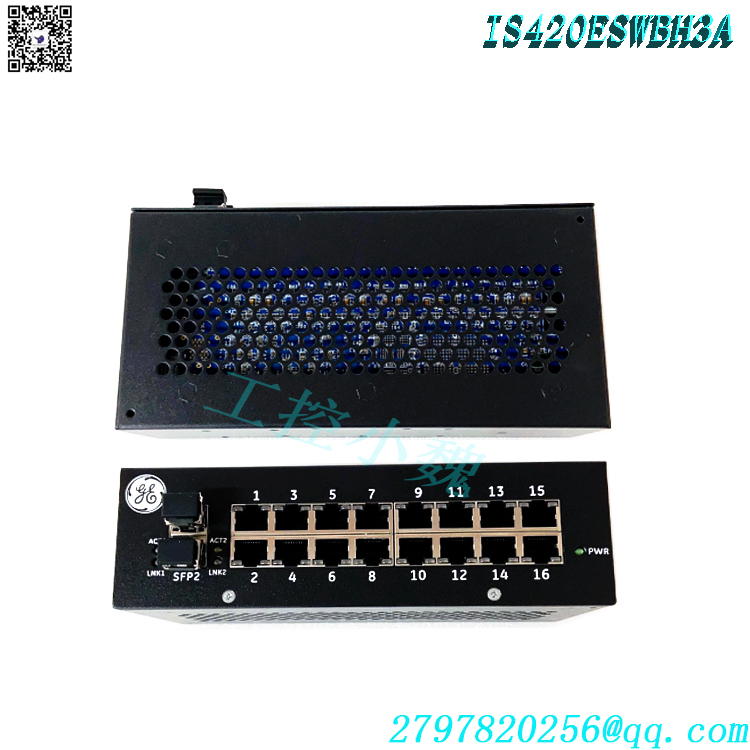
If the product model differs from the displayed image, the model number takes precedence. Please contact us for specific product photos; we can arrange for warehouse staff to take and provide confirmation images.
We operate 76 shared warehouses globally, so it may sometimes take a few hours to provide you with an accurate response; we appreciate your understanding. Rest assured, we will address your inquiries as quickly as possible.
IS420ESWBH3A Alternative Names:
ESWB Ethernet Switch IS420ESWBH3A
IS420ESWBH3A Mark VIeS Gas Turbine Control System
Speedtronic Mark VIe IS420ESWBH3A
IS420ESWBH3A Mark VIe 16-Port IONet Switch
Product Overview
The IS420ESWBH3A is an unmanaged industrial Ethernet switch designed for the IONet within GE Vernova’s Mark VIe and Mark VIeS turbine control systems. Part of the ESWB series, it features sixteen 10/100Base-TX RJ45 copper ports (with no fiber-optic interfaces). Engineered for the real-time transmission of unit control data, it serves as core switching hardware for the IONet network, enabling deterministic industrial Ethernet communication between controllers, distributed I/O racks, and HMIs. It is a critical network component within the safety control system architecture for gas and steam turbines.
I. Operating Principle
The IS420ESWBH3A utilizes a Layer 2 store-and-forward hardware switching architecture compliant with IEEE 802.3, 802.3u, and 802.3x Ethernet standards. It establishes a dedicated real-time data exchange channel for the Mark VIe IONet bus. As an unmanaged device, it lacks web-based login, VLAN configuration, or QoS customization capabilities; switching logic is hard-coded in hardware, and system policies are centrally managed by the Mark VIe controller.
Automatic MAC Address Learning and Directed Packet Forwarding: It features a built-in 4K MAC address table that automatically identifies the MAC addresses of controllers and I/O modules on the IONet network upon power-up. Upon receiving a data packet, it reads the destination MAC address and forwards the packet directly to the target port, thereby reducing network-wide broadcast flooding and the probability of network collisions.
Hardware Buffering and Flow Control: Equipped with a 256KB independent packet buffer per port, it automatically queues and buffers packets during concurrent multi-port data transmission, forwarding them using a First-In-First-Out (FIFO) mechanism. It supports 802.3x flow control; when the buffer is full, it sends a pause frame to the sender to temporarily halt transmission, effectively preventing packet loss during high-load scenarios and prioritizing the transmission of protection interlock packets.
Port Auto-Negotiation: All RJ45 ports support auto-negotiation for 10/100 Mbps speeds and full-duplex/half-duplex modes. Integrated HP-MDIX automatic cable detection eliminates the need to distinguish between straight-through and crossover cables. Dual-color LED indicators on the ports provide real-time feedback on link status, data transmission/reception, speed, and duplex mode.
Diode-OR Redundant Power Supply Logic: It is equipped with dual 28V DC power inputs operating in parallel. If one power source fails or disconnects, the other seamlessly takes over the power supply without interrupting IONet network communication, thereby eliminating single points of failure in the power supply. Power-on Self-Test (POST) Mechanism: The module automatically performs a hardware self-test upon power-up, checking the status of power circuits and port circuitry. Once the self-test passes, the ports enter a ready state; if a hardware fault is detected, the panel indicator light issues a fault alert.
II. Core Product Advantages
Native Compatibility with Mark VIe Systems & Deterministic Low-Latency Communication: Specifically developed for the GE Mark VIe/Mark VIeS turbine control system IONet network. Unlike standard commercial IT switches, the hardware is optimized for EGD real-time control packets, ensuring stable and controllable forwarding latency. It meets millisecond-level communication requirements for safety loops—such as overspeed protection, vibration interlocking, and emergency shutdowns—while suppressing packet jitter.
Industrial-Grade Rugged Design & High Environmental Resilience: Features fanless natural convection cooling and meets G3 industrial environmental standards. It offers excellent resistance to vibration and shock, as well as superior electromagnetic compatibility (EMC), enabling stable long-term operation in harsh power plant environments characterized by high temperatures, strong electromagnetic noise, and continuous vibration.
Dual-Path Redundant Power Supply & High System Availability: Supports dual DC redundant power inputs with seamless failover. Failure of a single power path does not interrupt the IONet network, preventing unit trips caused by switch power loss. It supports various system topologies, including TMR (Triple Modular Redundancy), dual redundancy, and single-system configurations.
High-Density 16-Port Copper Interface & Simplified Field Cabling: Equipped with 16 RJ45 electrical ports, a single unit can connect to multiple distributed I/O racks and controllers. This reduces intermediate network nodes, facilitates a star-topology IONet setup, minimizes potential points of failure associated with additional network equipment, and eliminates fiber-optic cabling costs.
Zero-Configuration Unmanaged Architecture & Reduced Operational Risk: Switching logic is hard-coded into the hardware; there is no need to configure network parameters such as IP addresses or VLANs, allowing for immediate operation upon power-up. There is no risk of network paralysis caused by accidental parameter changes by maintenance personnel; replacing spare parts requires only matching the DIP switch or jumper settings.
Hardware-based broadcast storm suppression: Hardware circuitry limits the forwarding intensity of broadcast packets, preventing broadcast storms—triggered by I/O module anomalies or cable short circuits—from consuming bandwidth, thereby ensuring the continuous availability of transmission channels for unit protection messages.
Flexible, standardized installation: Supports DIN-rail mounting or cabinet panel mounting, complying with power plant control cabinet installation standards; the unit is easy to install and remove, enhancing the efficiency of spare part replacement.
III. Applicable Industries and System Functions
Applicable Industries
Gas-fired combined-cycle power plants, thermal power stations, cogeneration projects, gas turbine-driven units in the oil and gas industry, industrial steam turbine units, and marine gas turbine propulsion control systems; primarily used with turbine units equipped with GE Mark VIe / Mark VIeS control systems.
Role in the Control System
Establishes the IONet real-time communication backbone network: Acts as a relay hub for the Mark VIe system’s IONet network, connecting main controllers, remote I/O racks, process data acquisition modules, and HMIs (Human-Machine Interfaces) to build a distributed turbine control LAN; facilitates bidirectional transmission of control commands, field analog and digital signals, as well as unit alarm and diagnostic data.
Ensures reliable communication for unit safety protection links: Safety protection signals—such as those for overspeed, shaft vibration, temperature interlocks, and emergency shutdowns—are transmitted via the IONet network; the switch ensures stable packet forwarding, guaranteeing low-latency and reliable delivery of protection signals to the controller, thereby preventing protection failure due to communication interruptions and averting major equipment accidents.
Aggregation of Distributed I/O Measurement Data and Command Distribution: Aggregates field measurement data—such as temperature, pressure, vibration, and valve position—collected by I/O modules in distributed cabinets and uploads it to the Mark VIe main controller. Simultaneously, it distributes closed-loop control commands from the controller (e.g., for speed regulation, fuel valves, and inlet guide vanes) to field I/O modules, ensuring stable regulation of the turbine unit.
Transmission of System Diagnostics and Status Monitoring Information: Responsible for transmitting diagnostic information—such as module self-test results, port disconnections, power supply anomalies, and network packet loss—to the controller and HMI. This enables operations and maintenance personnel to monitor the health of the IONet network in real-time and rapidly locate network faults.
Supporting Dynamic Regulation Across All Operating Conditions: Maintains uninterrupted exchange of massive amounts of real-time measurement data and control commands during transient conditions—such as unit startup, load ramping, and load rejection—thereby ensuring the stable operation of the gas and steam turbine closed-loop control systems.
IV. Standard Operating Procedures
Important Note: This device is a component of the power plant turbine safety control system. All installation, replacement, and removal operations must be performed only after the unit has been shut down, the system has been de-energized, and the Lockout/Tagout (LOTO) safety isolation procedure has been executed. Hot-swapping network ports or modules while the system is powered will directly cause an IONet network interruption and poses a risk of unit tripping.
Verification of Spare Part Information: Before replacing a spare part, record the DIP switch and jumper settings of the existing IS420ESWBH3A unit. The new spare part must strictly replicate these original settings to ensure the IONet network topology identification remains consistent.
Hardware Installation and Securing: Snap the switch onto the standard DIN rail and lock it in place, ensuring the module is securely fastened to prevent loosening due to vibration. Leave ventilation gaps above and below the module to facilitate natural convection cooling; do not obstruct the ventilation areas on the module housing. Power Wiring: Connect two redundant 28V DC power supplies according to the project drawings, ensuring correct polarity and securely tightening the terminals. Ground the cable shielding in accordance with standards. It is recommended to source the two power supplies from independent circuits to achieve true power redundancy.
Network Cable Termination: Use industrial shielded twisted-pair cables to connect the Mark VIe controller and I/O rack communication cables to the corresponding RJ45 ports. HP-MDIX auto-sensing eliminates the need to distinguish specific wire pinouts; however, the cable shield must be grounded at a single point to prevent ground loops.
Power-up and Hardware Status Check: After wiring is complete, verify there are no short circuits, remove safety isolations, and power up the system sequentially. Observe the main power LED and the Link/Act indicators on each port. A steady light indicates a link is established, while a flashing light indicates data transmission/reception. If no link is detected, troubleshoot the network cable, connectors, and the status of the connected I/O or controller module.
System Communication Verification: After powering up, check the IONet network status via the Mark VIe HMI or controller diagnostic interface to confirm that all I/O nodes are communicating correctly, with no packet loss or communication alarms. Conduct single-point failure tests to verify that dual power supply switching and single-port disconnection do not disrupt the operation of the entire IONet network.
Shutdown and Removal: Shut down the unit and follow the “Lockout/Tagout” (LOTO) procedure. Disconnect the RJ45 network cables first, then remove the power wiring, and finally detach the module from the DIN rail. Hot-plugging network cables while the system is powered is strictly prohibited.
V. Precautions for Use
Prohibition of Hot-Plugging: The IS420ESWBH3A is a network hardware component for a safety control system. Hot-plugging network cables or removing modules while powered will instantly interrupt IONet communication; in an operating unit, this can easily trigger a protective trip, resulting in unplanned downtime and associated losses.
Proper Grounding and Prevention of Ground Loops: The shield of the shielded twisted-pair cable must be grounded at a single point; grounding at both ends is prohibited. Poor grounding introduces common-mode interference, leading to elusive, hard-to-reproduce faults such as sporadic packet loss and intermittent communication drops.
Environmental and Thermal Management: Keep the interior of the control cabinet clean, as the accumulation of dust and oil residue impairs heat dissipation. The device utilizes fanless cooling; ensure adequate ventilation space above and below the module—do not stack multiple units tightly together. Operation in environments with condensation or corrosive gases is prohibited.
Communication Cable Selection: Industrial-grade shielded twisted-pair cables must be used. Standard commercial-grade network cables lack sufficient electromagnetic interference (EMI) resistance and are prone to communication anomalies in the high-EMI environments typical of power plants. Ensure RJ45 connectors are securely crimped to prevent loosening caused by long-term vibration.
Prohibition of Unauthorized Hardware and Firmware Modifications: This switch is a fixed-hardware, non-managed device with no network configuration interface. Attempting to flash firmware or modify internal circuitry is prohibited; hardware alterations invalidate the Mark VIe system’s security certification and functional safety qualifications.
Spare Part Version Compatibility: When replacing a unit, verify that the hardware version and model identifier (IS420ESWBH3A) match exactly. Direct replacement with a different hardware version is not permitted, as this may result in IONet protocol compatibility issues.
Fault Troubleshooting Principles: In the event of port anomalies or network communication alarms, prioritize checking network cables, connectors, grounding, and power supply circuits. Conclude that the module hardware is damaged only after confirming that all external wiring is functioning correctly. Do not attempt to disassemble or repair faulty modules on-site; instead, return them to the factory for inspection in accordance with spare parts procedures.
On-site Safety Control: This device is a safety-critical component for turbine systems. Installation and maintenance activities must strictly adhere to the power plant’s work permit system and implement “Lockout/Tagout” (LOTO) procedures—including power disconnection, voltage verification, and tagging/locking—to prevent safety accidents caused by accidental re-energization. Conclusion
The IS420ESWBH3A GE IONet Ethernet switch serves as an indispensable network hub for the Mark VIe turbine control system. Leveraging industrial-grade ruggedized hardware, dual-redundant power supplies, and deterministic Layer 2 hardware switching capabilities, it ensures the stable transmission of real-time control and protection signals within safety control networks for gas and steam turbines. Strict adherence to installation protocols and grounding and cabling requirements minimizes the likelihood of IONet network failures, thereby guaranteeing the long-term, safe, and stable operation of the generating units.
IS420ESWBH3A manual, white paper, data sheet, and troubleshooting
GEH-6725 Mark VIe and Mark VIeS Control Equipment HazLoc Manual IS420ESWBH3A.pdf
GEH-6855_ Vol_ I IS420ESWBH3A Mark VIeS Functional Safety System Volume 1 System Guide Manual PDF
GEH-6855_ Vol_ II Mark VIeS Functional Safety System Manual IS420ESWBH3A.pdf
Mark VIeS Functional Safety System Equipment in GEH-6861 HazLoc IS420ESWBH3A. pdf
IS420ESWBH3A IONet Switch Datasheet. pdf
Warehouse model recommendation:
ABB DSTX-W110-57160001-AAP
ABB DSTD-W150-57160001-AAK
LIAAEN HELITRON E4-E6-CPU-IO-MODULE1
SUZHOU BEIJIAAN EXPLOSION-PROOF
SUZHOU BEIJIAAN EXPLOSION-PROOF
IS200TTURH1CFD
IS200WEMAH1AEA
IS200AEPAH1AHD
IS200WETAH1AEC
IS200WREAS1ADB
IS200AEPAH1ACB
IS200AEPAH1AFD
IS200AEPCH1ABC
IS200BPPBH2BJD
IS200AEPCH1ABC
IS200TREAH2AED
IS200STCIH6AED
IS200SRTDH2ACB
IS200TVBAH2ACC
IS200TRLYH1BHH
IS200WEORG1A
IS200ESELH1A
IS200AEPGG1AAA
IS200TSVCH2AED
IS200EPMCH1
IS200JPDSG1A
IS220PPDAH1A
IS210JPDHG1A
IS220YSILS1B
IS200SCSAS1A
IS200WCSAS1A
IS220YSILS1A
IS200TCSAS1A
IS200WNPSS1A
IS41yJPDDG2A
IS41yJPDDG3A
IS40yJPDGH1A
IS411JPDHG1A
IS4210UCSBH4A
more……


admin –
The industrial Ethernet switch IS420ESWBH3A is part of the Mark VIe security control system designed by General Electric. This switch does not have fiber optic ports, but has 16 copper ports, which are 10/100Base-TX RJ45 ports.
admin –
IS420ESWBH3A is an Ethernet IONet switch that is part of the GE Speedtronic Mark VIe gas turbine control system. It has 8 ports and 10/100BASE-TX. The ESWB Ethernet 10/100 switch is designed specifically to meet the requirements of real-time industrial control solutions and is essential for all IONet switches used in Mark VIe and VIeS security control systems. It is a DIN rail mounting module. In order to meet the requirements of speed and functionality, the following functions are provided.
IS420ESWBH3A is an Ethernet IONet switch that is part of the GE Speedtronic Mark VIe gas turbine control system. It has 8 ports and 10/100BASE-TX. The ESWB Ethernet 10/100 switch is designed specifically to meet the requirements of real-time industrial control solutions and is essential for all IONet switches used in Mark VIe and VIeS security control systems. It is a DIN rail mounting module. In order to meet the requirements of speed and functionality, the following functions are provided.
admin –
IS420ESWBH3A manual, white paper, data sheet, and troubleshooting
GEH-6725 Mark VIe and Mark VIeS Control Equipment HazLoc Manual IS420ESWBH3A.pdf
GEH-6855_ Vol_ I IS420ESWBH3A Mark VIeS Functional Safety System Volume 1 System Guide Manual PDF
GEH-6855_ Vol_ II Mark VIeS Functional Safety System Manual IS420ESWBH3A.pdf
Mark VIeS Functional Safety System Equipment in GEH-6861 HazLoc IS420ESWBH3A. pdf
IS420ESWBH3A IONet Switch Datasheet. pdf
admin –
Role in Network Architecture
The Mark VIe system comprises several isolated networks: the upper layers include the UDH (Unit Data Highway, for HMIs) and PDH (Plant Data Highway, for historical data collection), while the lower layer is the IONet—a real-time control network connecting controllers and I/O modules. The IS420ESWBH3A is dedicated to the IONet and forwards process data requiring real-time performance; consequently, GE mandates the use of genuine ESWA/ESWB switches for the IONet, as standard commercial switches fail to meet system requirements regarding latency and reliability.
Hardware Specifications
Ports: 16 × 10/100Base-TX copper ports (RJ-45); supports auto-negotiation (full/half-duplex) and IEEE 802.3/802.3u/802.3x standards (including flow control);
HP-MDIX auto-crossover detection; compatible with both straight-through and crossover cables, eliminating the need for specific wiring sequences;
Power Supply: 24/28 VDC, 1 A max; dual independent power inputs via TB1/TB2 terminals with Diode-OR redundancy—ensures uninterrupted operation if one power source fails;
Forwarding Capability: Minimum 256 KB packet buffer and 4K MAC address table; capable of handling IONet broadcast spikes and preventing packet loss;
Dimensions: 18.8 × 8.6 × 5.6 cm (H×W×D); natural convection cooling (fanless);
Environmental: Operating temperature -40 to +70°C, storage temperature -40 to +85°C; rated for Class 1 Div 2 / Class 2 Zone 2 / ATEX hazardous areas; G3 corrosion resistance rating;
Indicators: Dual-color LED per port indicating link, activity, and duplex/speed status, plus a power LED; facilitates intuitive on-site troubleshooting.Key Application Points
Plug-and-Play: As an unmanaged Layer 2 switch, it requires no configuration and operates immediately upon power-up, adhering to the control system principle of “minimal configuration, minimal errors.”
Installation: DIN-rail mountable; however, rail clips must be ordered separately—use model 259B2451BVP1 for mounting with the long side parallel to the rail, and model 259B2451BVP4 for mounting perpendicular to the rail (specific to the 16-port ESWB).
Cabling: Standard Cat 5e UTP Ethernet cables are suitable for copper ports; cable length should adhere to the 100-meter standard for copper cabling.
Replacement: This model is currently in the “Active” lifecycle stage; the official replacement part number is IS420ESWBH3A, ensuring easy procurement and seamless compatibility.
https://www.weikunfadacai1.com/product/ge-mark-vie-is420eswbh3a-in-stock-now-most-orders-ship-the-same-day/
admin –
Establishes the IONet real-time communication backbone network: Acts as a relay hub for the Mark VIe system’s IONet network, connecting main controllers, remote I/O racks, process data acquisition modules, and HMIs (Human-Machine Interfaces) to build a distributed turbine control LAN; facilitates bidirectional transmission of control commands, field analog and digital signals, as well as unit alarm and diagnostic data.
Ensures reliable communication for unit safety protection links: Safety protection signals—such as those for overspeed, shaft vibration, temperature interlocks, and emergency shutdowns—are transmitted via the IONet network; the switch ensures stable packet forwarding, guaranteeing low-latency and reliable delivery of protection signals to the controller, thereby preventing protection failure due to communication interruptions and averting major equipment accidents.
Aggregation of Distributed I/O Measurement Data and Command Distribution: Aggregates field measurement data—such as temperature, pressure, vibration, and valve position—collected by I/O modules in distributed cabinets and uploads it to the Mark VIe main controller. Simultaneously, it distributes closed-loop control commands from the controller (e.g., for speed regulation, fuel valves, and inlet guide vanes) to field I/O modules, ensuring stable regulation of the turbine unit.
Transmission of System Diagnostics and Status Monitoring Information: Responsible for transmitting diagnostic information—such as module self-test results, port disconnections, power supply anomalies, and network packet loss—to the controller and HMI. This enables operations and maintenance personnel to monitor the health of the IONet network in real-time and rapidly locate network faults.
Supporting Dynamic Regulation Across All Operating Conditions: Maintains uninterrupted exchange of massive amounts of real-time measurement data and control commands during transient conditions—such as unit startup, load ramping, and load rejection—thereby ensuring the stable operation of the gas and steam turbine closed-loop control systems.
https://www.weikunfadacai1.com/product/ge-mark-vie-is420eswbh3a-in-stock-now-most-orders-ship-the-same-day/