
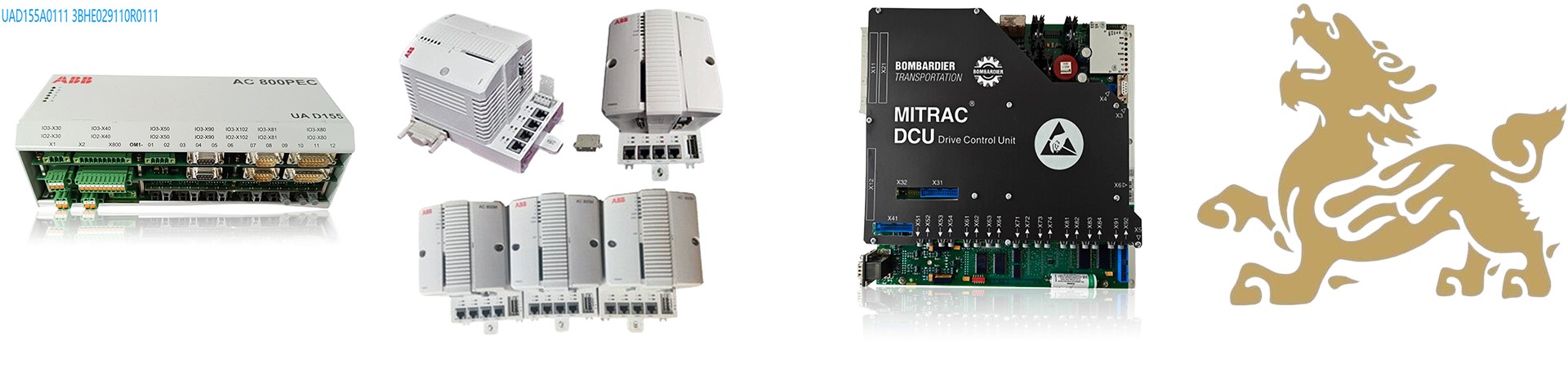
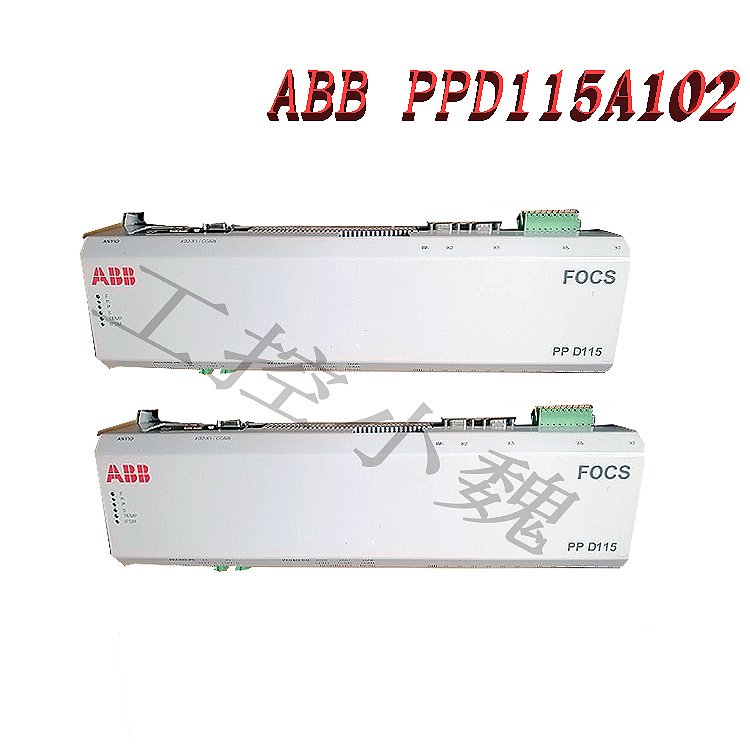
.jpg "PPD113B01-10-150000 3BHE023784R1023(1)")
.jpg "PPD512 A10-15000 3BHE040375R1023(3)")
.jpg "PPD512 A10-15000 3BHE040375R1023(2)")
Description
Many products have not yet been launched, please contact us for more products
If the product model does not match the displayed image, the model shall prevail. Please contact us for specific product images, and we will arrange for photos to be taken in the warehouse for confirmation
We have 16 shared warehouses worldwide, so sometimes it may take several hours to accurately return to you. We apologize for any inconvenience caused. Of course, we will respond to your concerns as soon as possible.
PPD113B03 3BHE023584R2365 Other names:
Excitation controller module PPD113B03 3BHE023584R2365
PPD113B03 3BHE023584R2365 editable controller
Analog module PPD113B03 3BHE023584R2365
The ABB PPD113B03 3BHE023584R2365 excitation processor module is an important component of motor control systems, mainly used to control the excitation system of motors, generators, or other equipment to maintain their stable operation. This module is a modular digital exciter produced by ABB for the excitation system of AC generators. It consists of two independent digital controllers, each of which can control an excitation transformer. This module has the characteristics of digital control, modular design, easy installation and maintenance, and multifunctionality, and can be used for excitation control of various AC generators.
The following is a detailed introduction to the ABB excitation processor module:
Main functions
The main functions of ABB excitation processor module PPD113B03 3BHE023584R2365 include:
Provide excitation current: By supplying DC excitation current to the magnetic field coils of the motor, the magnetic field strength and direction of the motor can be changed.
Precise control: Achieve precise control of motor speed, torque, and power factor, improving motor performance and stability.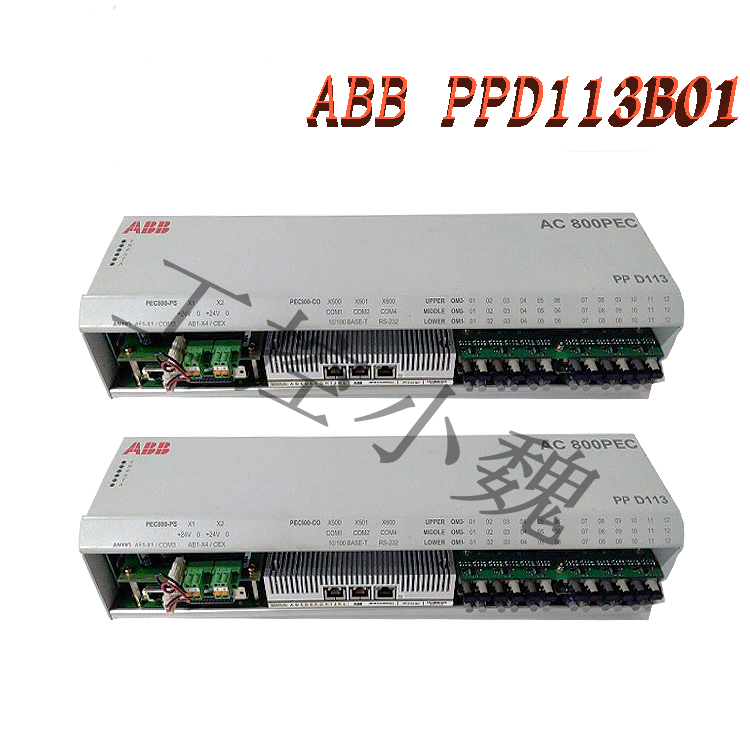
Monitoring and Protection: Monitor the excitation current to ensure that the equipment operates under correct electrical conditions and provide protective measures when necessary.
Working principle
The working principle of ABB excitation processor module PPD113B03 3BHE023584R2365 is based on the principle of electromagnetic induction. When the exciter is powered on, a magnetic field is generated around it, which interacts with the rotating magnetic field of the generator to form an electromotive force, and then generates current in the winding of the generator to drive it to rotate.
Core components
The ABB excitation processor module PPD113B03 3BHE023584R2365 typically includes the following core components:
Excitation transformer: responsible for converting AC voltage into DC voltage suitable for motor excitation.
Rectifier: using full bridge rectification method to convert the AC voltage output by the transformer into a stable DC voltage, which is supplied to the magnetic field coil of the motor..jpg)
Filter capacitor: used to smooth the output voltage waveform, reduce voltage ripple and noise, and ensure the smoothness of motor operation.
Type and Characteristics
The ABB excitation processor module PPD113B03 3BHE023584R2365 can be classified according to different application scenarios and requirements, such as DC excitation system, variable ratio excitation system, speed regulation excitation system, etc. Each type of excitation module has its unique characteristics and advantages, which can meet the operational needs of different motors under different working conditions. For example,PPD113B03 3BHE023584R2365 is a modular digital exciter produced by ABB for AC generator excitation systems, which has the characteristics of high precision, good stability, and modular design.
Application scenarios
The ABB excitation processor module PPD113B03 3BHE023584R2365 is widely used in control systems for large electromechanical equipment such as generators, motors, and wind turbines. They achieve efficient and stable operation of the motor through precise excitation control, improving the reliability and economy of the entire power system..jpg)
Technological development trends
With the continuous development and innovation of power electronics technology, the performance and reliability of ABB excitation processor modules are also constantly improving. In the future, the excitation processor module will become more intelligent and integrated, providing strong support for the further development of motor control technology.
In summary, the ABB excitation processor module is an indispensable key component in motor control systems, which is of great significance for improving motor performance and stability.
All products on this website are special products, and market prices have been fluctuating,
Please refer to the customer service quotation for details, as the product is new and the price is not genuine,
Please confirm the model, product, price, and other detailed information with customer service before placing an order. The website has been used,
The new one is for sale, please contact customer service for further communication.
Model recommendation:
PPD113B01-10-150000
PPD113B01-10-150000 3BHE023784R1023
PPD113B03-26-10011
PPD113B03-26-100110 3BHE023584R2634
PPD103B101
PPD103B101 3BHE02384R2630
PPD103B101 3BHE020455R0101
PPD103B101 3BHE020455R0101 3BHE02384R2630
PPD113-B03-23-111615 3BHE023584R2365
PPD113-B03-23-111615
GFD233A101 3BHE022294R0101
GFD563A101 3BHE046836R0101
GFD563A102 3BHE046836R0102
GF D563 3BHE046836R010
GFD233A103 control module
GFD563A102
GFD563A101
GFD233A101
3BHE022294R0101
more……
admin –
The ABB PPD113B03 3BHE023584R2365 excitation processor module is an important component of motor control systems, mainly used to control the excitation system of motors, generators, or other equipment to maintain their stable operation. This module is a modular digital exciter produced by ABB for the excitation system of AC generators. It consists of two independent digital controllers, each of which can control an excitation transformer. This module has the characteristics of digital control, modular design, easy installation and maintenance, and multifunctionality, and can be used for excitation control of various AC generators.
admin –
System: ABB AC800PEC Power Electronics High-Speed Control Platform, with UNITROL Static Excitation System
Core Hardware Architecture
750MHz 64-bit floating-point RISC main processor + programmable FPGA dual-core architecture
Minimum control cycle 25μs, meeting millisecond-level rapid excitation adjustment and transient response to grid faults
Fiber optic CEX bus, Ethernet, AnyBus multiple communication interfaces
24VDC power supply, rack-mountable plug-in installation, full-board tri-proof coating suitable for dusty/humid power plant environments
Core Positioning: The sole computing core of the excitation system, distinct from ordinary I/O boards and trigger boards.
Core Excitation Control Functions (R23 Hardware Version)
AVR Automatic Voltage Regulation: Constant Voltage / Constant Reactive Power / Constant Power Factor Closed-Loop Regulation
Protection Limiting Logic: Overexcitation OEL, Underexcitation UEL, V/Hz Limit, Rotor Overcurrent, Inverter Demagnetization Interlock
PSS Power System Stabilizer: First-generation PSS2 algorithm, suppressing low-frequency oscillations of the unit (PSS4 not supported)
Signal Acquisition and Calculation: High-speed sampling and calculation of PT terminal voltage, CT stator current, and rotor excitation feedback
Pulse Trigger Output: Sends high-speed trigger pulses to the thyristor power unit
Fault Diagnosis and Recording: System alarms, event logs, and fault waveform storage
External Communication: Modbus TCP, Profibus and DCS/Host Computer interaction for unit reactive power, voltage, and fault signals
Core Excitation Control Functions (R23 Hardware Version)
AVR Automatic Voltage Regulation: Constant Voltage / Constant Reactive Power / Constant Power Factor Closed-Loop Regulation
Protection Limiting Logic: Overexcitation OEL, Underexcitation UEL, V/Hz Limit, Rotor Overcurrent, Inverter Demagnetization Interlock
PSS Power System Stabilizer: First-generation PSS2 algorithm, suppressing low-frequency oscillations of the unit (PSS4 not supported)
Signal Acquisition and Calculation: High-speed sampling and calculation of PT terminal voltage, CT stator current, and rotor excitation feedback
Pulse Trigger Output: Sends high-speed trigger pulses to the thyristor power unit
Fault Diagnosis and Recording: System alarms, event logs, and fault waveform storage
External Communication: Modbus TCP, Profibus, and DCS/Host Computer interaction for reactive power, voltage, and fault signals
Applicable Unit Scenarios
Small and medium-sized thermal power turbine generators, conventional hydro turbine generator sets, and gas turbine units. UNITROL5000 Early Excitation Cabinets
ABB excitation systems commissioned earlier (manufactured before 2010), later upgraded to [specific models not provided in the original text]. Version R2634
Firmware Upgrade Criteria (for 3BHE023584R2365 / PPD113B03-23)
Hardware Constraints: Only firmware packages from the R23 branch can be upgraded; newer firmware versions from the R26 series cannot be flashed; hardware limitations lock functional boundaries.
Upgrade Required Scenarios
ABB Official Release – R26 Hardware Firmware Bug Announcement (Communication Intermittent Loss, LVRT Failure, Redundancy Switching Fluctuations)
Frequent Reports of Watchdog Resets, Oscillation Adjustment, and Waveform Recording Loss in the Field
New Power Grid Standards Not Supported by Existing Firmware (R23 hardware cannot implement the new cross-connection function; only a complete hardware replacement with R26 is possible) (Board)
The firmware versions of the two boards in the redundant cabinet are inconsistent, and the switching test fails.
Scenarios where no upgrade is required
The unit operates stably for a long time without software alarms or regulation anomalies.
No need for grid standard upgrades; downtime upgrade costs are too high.
Upgrade requires mandatory pre-operation.
Complete backup of excitation parameters, limit curves, and communication mapping; full testing and verification of no-load voltage boost, reactive power regulation, and main/standby switching after the upgrade.