
.jpg "FOXBORO(1)")
Description
All products on this site are specialized items subject to fluctuating market prices.
Actual pricing is based on quotes provided by customer service; listed prices are not final.
Please confirm the model, product details, and price with customer service before placing an order.
New units are available for sale; please contact customer service for details.
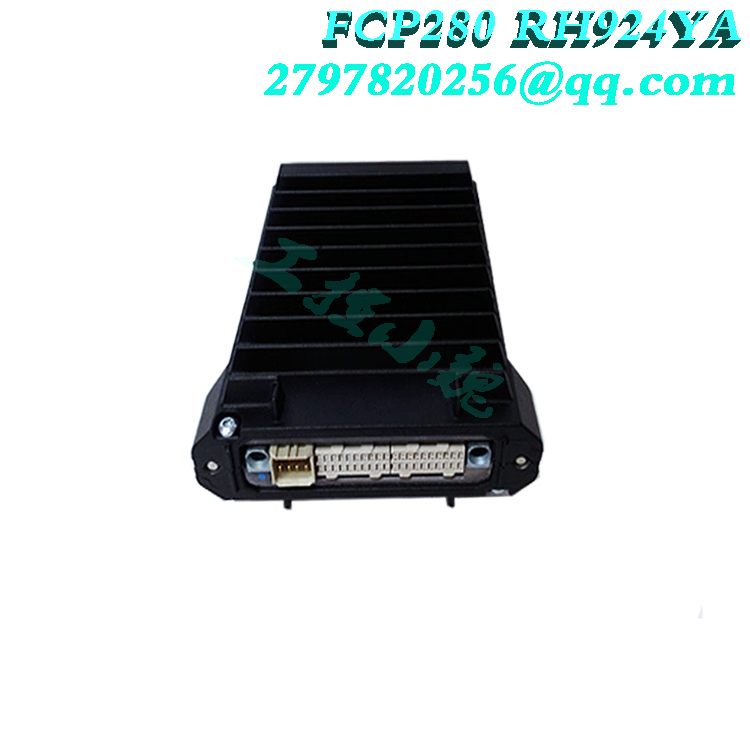
The RH924UQ is a component of the Foxboro I/A Series Evo DCS system. While often labeled in the market as a “Field Control Processor,” strictly speaking, the RH924UQ is not the processor unit itself but a copper-cable Mesh network adapter designed for the FCP280 Field Control Processor. The FCP280 serves as the core for control computations, while the RH924UQ acts as a network interface module installed in a slot on the FCP baseplate; it is powered directly by the FCP baseplate and requires no external power supply.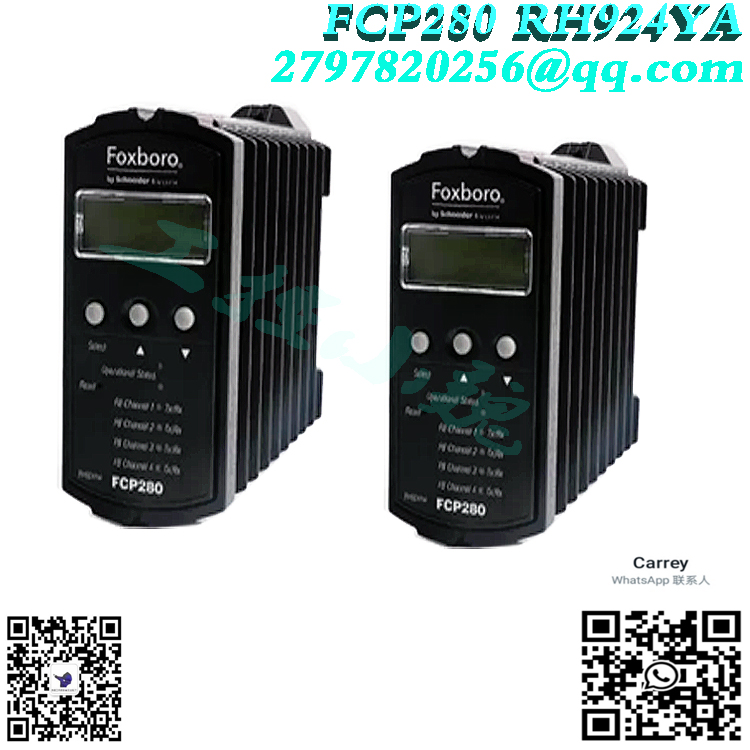
The RH924UQ provides a 100BASE-TX standard RJ45 Ethernet interface, connecting the FCP280 to the DCS redundant Mesh control network. This enables bidirectional transmission of real-time process data, alarm events, and configuration files between the FCP controller and operator stations, historian stations, and other controllers. In a fault-tolerant redundant FCP configuration, the FCP baseplate can accommodate two RH924UQ modules, each connected to a separate control switch to establish an A/B dual-redundant network architecture. If a single network cable or switch port fails, the system can switch seamlessly to the backup link without interrupting field control operations. The RH924UQ handles only physical-layer data forwarding and does not participate in PID regulation, logic operations, or sequence control execution; all control algorithms, SOE event acquisition, and FBM field I/O module management are performed by the FCP280 processor. The module features built-in hardware link diagnostics that monitor for network anomalies—such as cable disconnections or link loss—in real time. Diagnostic information is transmitted to the FCP280 to trigger network alarms on the HMI, enabling maintenance personnel to quickly locate communication faults. The RH924UQ is designed for the FCP280 baseplate and features a mechanical interlock mechanism to prevent accidental insertion into slots intended for the fiber-optic version (RH924WA) of the same series. While the RH924UQ is suitable for short-range Mesh networking within a cabinet, the RH924WA utilizes a multimode fiber interface for long-range networking between cabinets. The module’s operating environment specifications align with those of the FCP280, with an operating temperature range of -20°C to 60°C, meeting industrial requirements for vibration and electromagnetic compatibility in sectors such as petrochemicals, coal chemicals, and power plants.
System data flow: The FBM (Fieldbus Module) connects to the FCP280 via the HDLC fieldbus. After the FCP280 completes control calculations, data is transmitted through the RH924UQ copper adapter on the baseplate and an RJ45 network cable to the Mesh control switch.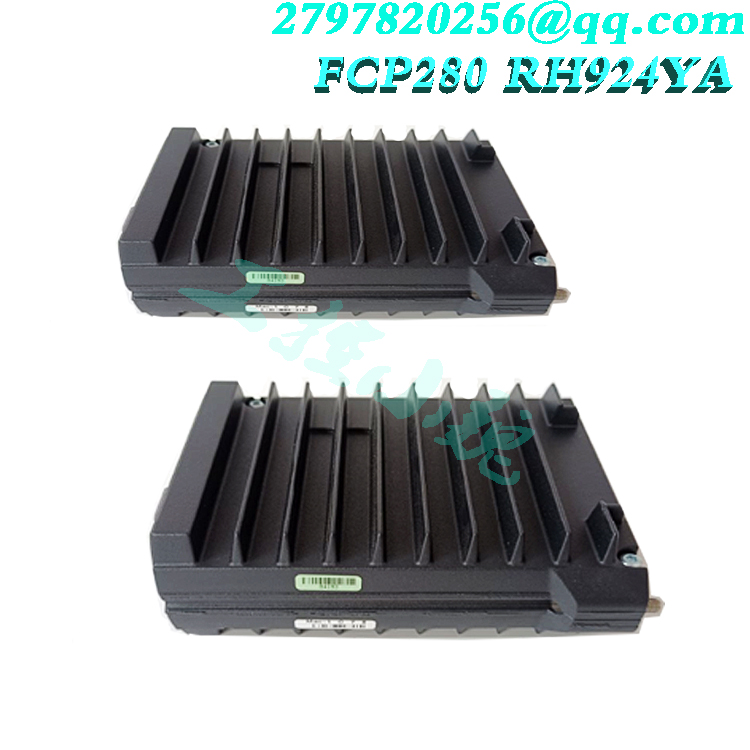
Regarding field maintenance, the RH924UQ supports hot-swapping; however, in redundant FCP operating modes, the status of the alternative network link must be verified as normal before replacing the module to prevent simultaneous disconnection of both network paths. For troubleshooting, if the FCP reports a control network link failure and the network port indicator is off—and the fault persists after replacing the network cable and switch port—the RH924UQ can be swapped to another slot on the baseplate. Observing whether the alarm signal follows the module helps distinguish between a module failure and an FCP baseplate failure. An RH924UQ failure only interrupts communication on the corresponding network channel; the FCP controller’s loop control functions continue to operate, preventing a direct loss of field control.
The RH924UQ is a copper Mesh network adapter designed for the Foxboro Evo DCS FCP280 controller. It provides redundant Ethernet communication capabilities for the field control processor and serves as a critical physical interface component within the DCS control network.
Model recommendation:
FCP280 FOXBORO
FCP270 P0917YZ FOXBORO
FCP280 RH924YA FOXBORO
FOXBORO H92904CC0500
FOXBORO H929049B0500
FBI10E FOXBORO
FBM02 FOXBORO
FBM03 FOXBORO
FBM04 FOXBORO
FBM05 FOXBORO
FBM07 FOXBORO
FBM09 FOXBORO
FBM10 FOXBORO
FBM12 FOXBORO
FBM18 FOXBORO
FBM201 P0914SQ
FBM201D P0922YK
FBM201E P0924TR
FBM202 P0926EQ
FBM203 P0914SV
FBM204 P0914SY
FBM206 P0916CQ
FBM207 P0914TD
FBM207B FOXBORO
FBM207C RH917GY
FBM208 P0914TB
FBM211 FOXBORO
FBM214 FOXBORO
FBM214B P0927AH
FBM215 FOXBORO
FBM216 P0922VV
FBM216B P0927AJ
FBM218 P0922VW
FBM219 RH916RH
FBM223 P0917HD
More……
admin –
Fault-tolerant and redundant design
The fault-tolerant design of RH924UQ ensures that the system can continue to operate when a component fails, which is achieved in the following ways:
Dual processors: If one processor fails, the other processor automatically takes over to ensure that the control process is not interrupted.
Redundant power supply: Even if one power supply fails, the system can continue to supply power.
Redundant communication paths: Ensure that communication between the processor and other system components is not interrupted.
admin –
Core Identity: A core component of the FOXBORO EcoStruxure DCS system, the RH924UQ is a high-performance module in the FCP280 (Field Control Processor) series, designed specifically for industrial automation, distributed control systems (DCS), and process control. It supports collaboration with 200 series/100 series fieldbus modules (FBMs) to achieve regulation, logic, timing, sequential control, and data acquisition functions.
Technological Evolution: As an upgrade module to the FCP280, the RH924UQ integrates a fault-tolerant design (dual-processor architecture), supports online image upgrades (OLUG) without system downtime, adapts to the hardware compatibility requirements of the Foxboro automation platform, and complies with ISA EDSA cybersecurity certification standards.
Core Functions and Technical Parameters
Control and Communication Capabilities
Multi-Protocol Support: Integrates Ethernet (10/100/Base-T), RS485, Safe Ethernet, and Modbus TCP/RTU interfaces, is compatible with industrial communication standards (such as OPC UA), and supports remote monitoring and SCADA system integration.
Redundant Design: Employs a dual-processor architecture, achieving patented fault-tolerant operation to ensure high system availability; supports hot-swappable and self-hosted modes, allowing independent operation even without a host workstation.
Scalability: Supports up to 128 200 series FBMs or mixed configurations (e.g., 64 100 series + 64 200 series FBMs), adaptable to DIN rail/panel mounting, modular design facilitates expansion and maintenance.
Network Management: Integrates Ethernet, RS485, Modbus TCP/RTU, and other communication interfaces, supporting standard Ethernet connections for remote monitoring and data transmission, adaptable to Industrial Internet of Things (IIoT) scenarios.
Real-Time Processing: Supports real-time data acquisition, logic control, timing/sequential control, and alarm detection, ensuring precise control and rapid response in industrial processes.
Compatibility: Integrates with systems from ABB, Siemens, Honeywell, and other brands, supporting collaborative operation with PLCs, DCS, frequency converters, and other devices.
Hardware and Performance Parameters
Electrical Characteristics: Operating voltage range 120V AC/125V DC, adaptable to harsh industrial environments (G3 protection rating, operating temperature -20℃~60℃, IP66 protection rating), CE certified and explosion-proof certified (e.g., ATEX, IECEx).
Dynamic Performance: Supports high-speed data processing (e.g., 2Mbps HDLC fieldbus), millisecond-level response time, and 0.1% accuracy; integrated LCD display shows real-time status and error codes.
Storage and Security: Built-in non-volatile memory, supports data encryption and access control, ensuring system security and data integrity.
Intelligent Features and Industry Adaptability
Predictive Maintenance: Monitors hardware status through built-in diagnostic functions, providing early warnings of potential faults; supports remote debugging and firmware updates.
Industry Applications: Adaptable to industries such as oil/gas, chemical, power, metallurgy, water treatment, and food and beverage; supports generator set control, pump and valve regulation, process optimization, and other scenarios.
Scalability: Supports modular expansion, adaptable to complex application scenarios such as multi-axis control and multi-channel data acquisition.
Application Scenarios and Value
Typical Applications:
Industrial Automation: Production line control, robot collaboration, conveyor systems, pump and valve control, etc., improving production efficiency and equipment reliability.
Energy and Infrastructure: Power plant excitation control, grid synchronization, distributed energy systems, microgrid management, combined heat and power (CHP) control.
Process Industries: Process control and data acquisition in industries such as petrochemicals, metallurgy, pharmaceuticals, and food processing.
Special Environments: Equipment health management in offshore platforms, explosion-proof areas, and high/low temperature environments.
Performance Advantages: High reliability, strong scalability, multi-protocol compatibility, real-time data processing capabilities, reducing system downtime risk and improving production efficiency.
Installation and Maintenance Recommendations
Installation Specifications: Must be fixed to DIN rails or metal plate assemblies according to the instruction manual, ensuring good grounding and avoiding electromagnetic interference; sensor installation positions must be precisely aligned with monitoring points to ensure accurate signal acquisition.
Maintenance Requirements: Regularly calibrate sensors and check the status of connection lines and interfaces; clean module surfaces to prevent oil and dust from affecting heat dissipation and performance; regularly back up historical data for trend analysis and fault tracing.
Summary
The FOXBORO RH924UQ field control processor is a core component of industrial automation and DCS systems. It integrates high-precision control, redundant design, multi-protocol communication, and intelligent diagnostic functions, making it suitable for scenarios with extremely high system stability requirements, such as petroleum, chemical, power, and metallurgy industries. Its modular design, high reliability, and industry adaptability make it a key solution for industrial process control and digital transformation.
https://www.weikunfadacai1.com/product/rh924uq-foxboro/
admin –
RH924UQ | Comprehensive Analysis of FOXBORO Field Control Processor
Product Positioning and Core Functions
The RH924UQ is an industrial automation module from Schneider Electric’s FOXBORO brand, a core component of the EcoStruxure™ Foxboro™ DCS system. Its core functions include:
Multi-mode control: Supports regulation control, logic control, timing control, and sequential control; can execute complex feedforward and nonlinear control strategies; and is compatible with high-speed functions such as ladder logic and DPIDA.
Fieldbus integration: Connects to 200 series/100 series FBM modules via HDLC protocol (up to 128 modules per controller); supports independent connection to dual-cable backplanes; and is compatible with third-party protocols such as PROFIBUS and HART.
Fault-tolerant design: Employs dual-module parallel operation and bit matching technology; in case of primary module failure, the backup module automatically takes over, ensuring uninterrupted control and complying with ISA S84 safety standards.
Environmental Adaptability: The die-cast aluminum housing is CE certified and can operate stably in harsh G3 environments (high temperature, dust, vibration) without requiring a dedicated cabinet.
Technical Specifications and Parameters
Electrical Parameters: Supports 240V AC/125V DC input, rated for normal temperature and pressure environments, with power consumption as low as standard industrial levels.
Communication Capabilities: Standard 100Mbps Ethernet interface, supports fiber optic/copper cable connections, optional GPS time synchronization function to ensure multi-controller coordination accuracy.
Expansion Capabilities: Supports self-hosting mode (independent operation without a host workstation), provides online image upgrade (OLUG) function, and is compatible with migration of legacy systems such as Siemens APACS+ and Honeywell TDC2000.
Physical Characteristics: Compact module size (e.g., 11cm × 11.5cm × 4.5cm), weighing approximately 0.34kg, facilitating cabinet installation and maintenance.
Application Areas and Industry Cases
Process Industries: Widely used in chemical, oil and gas, power, pharmaceutical, and food and beverage industries, for example, in reactor temperature control, oil well automation, and cleanroom environmental monitoring.
Infrastructure: Used in wastewater treatment, building automation, aerospace, and other fields to monitor parameters such as flow rate, liquid level, and pressure, ensuring safe and efficient system operation.
Typical Scenarios: Generator set speed regulation, power grid load distribution, filling line speed control, fermentation process parameter management, etc.
Technical Advantages and Certifications
High Precision and Reliability: Employs advanced control algorithms and sensor technology to achieve micron-level positioning accuracy, passing rigorous quality testing (such as CE certification and ISA EDSA cybersecurity certification).
Ease of Maintenance: Modular design supports rapid installation and fault diagnosis; LCD display and LED indicators intuitively display system status, facilitating on-site maintenance.
Scalability: Supports independent dual-bus connection and redundant configuration, meeting the high availability requirements of large industrial systems.
https://www.weikunfadacai1.com/product/rh924uq-foxboro/
admin –
II. Core Functions
FCP280 Carrier and Bus Transmitter
Serving as the mounting base for the FCP280 controller, it supports the main control board and leads out two HDLC fieldbuses to connect to FBM series I/O input/output modules (200/100 series FBM); bus speeds support 2Mbps (200 series FBM) and 268Kbps (100 series FBM).
System Network Interface
The panel integrates an RJ45 Ethernet port, connecting to the DCS control X-NET network to achieve data interaction with operator stations, servers, and third-party PLCs; the panel includes Status/Stat indicator lights for real-time feedback on communication and operational faults.
Redundancy and Power Supply Adaptation
Supports dual-channel redundant 24VDC power supply; modules support hot-swapping; equipped with a standard rack backplane, allowing for paired deployment of single/redundant FCP controllers, millisecond-level seamless master/slave switching, ensuring uninterrupted continuous process control.
System Synchronization Expansion
It can be used with the RH924ZQ timing synchronization adapter to connect to time synchronization signals, meeting the high-precision timing acquisition requirements of power plants and refining plants; it is also compatible with the RH928CV bus splitter to expand multiple FBM fieldbuses.
III. Hardware Interfaces
Backend Gold Finger Bus: High-density multi-pin HDLC parallel bus, interface with rack backplane, transmits I/O real-time control data.
Frontend RJ45 Ethernet: X-NET DCS system network port, TCP/IP communication.
Status LED Indicators: Power, running, bus communication, network fault alarm.
Power Supply Terminals: Dual redundant 24VDC DC input.
IV. Key Technical Specifications
Item Parameters
Adaptor Controller: FCP280 field control processor
Power Supply: 24VDC dual-redundant, supports hot-swapping.
Bus Protocol: HDLC fieldbus (compatible with 100/200 series FBM I/O)
Network: 1-channel RJ45 Ethernet (X-NET DCS intranet)
Installation: Standard I/A series rack backplane DIN rail mounting.
Operating Temperature: 0℃ ~ 60℃, industrial wide temperature range, EMC interference resistant.
Certifications:CE, UL, CSA, and ATEX explosion-proof options available; IEC 61000 industrial electromagnetic compatibility.
Protection level IP20 (rack mounting)
V. Application Industry Scenarios
RH924UQ+FCP280 complete set is a core control unit for process industries:
Petroleum refining: Distillation and hydrogenation unit temperature/pressure PID closed-loop, batch sequential control
Thermal/Gas-fired power plants: Boiler, turbine auxiliary circuit, desulfurization and denitrification system control
Chemical/Pharmaceutical: Intermittent batch processes, safety interlock SLC logic
Water treatment, metallurgy, papermaking: Multi-variable continuous process regulation
VI. Differentiation of Models in the Same Series
RH924UQ: Standard single-port FCP280 base (general mainstream model)
RH924YA: High-end enhanced base, greater bus load capacity
RH924ZQ: Timing synchronization adapter (for use with RH924UQ) (Usage)
VII. Supplementary Notes
The RH924UQ cannot operate independently; it must be used with the FCP280 main control board to form a complete FCP field controller. Vendors often refer to them together as “FCP280 RH924UQ complete controller set.”
It is a key component in Schneider’s Foxboro I/A Evo generation, replacing the older FCP270 base. Original brand-new parts are still available, and there is a large supply of used, salvaged parts.
It features complete hardware self-diagnostics; indicator lights quickly locate bus disconnections, network interruptions, power failures, and main control board malfunctions.
https://www.weikunfadacai1.com/product/rh924uq-foxboro/
admin –
The RH924UQ provides a 100BASE-TX standard RJ45 Ethernet interface, connecting the FCP280 to the DCS redundant Mesh control network. This enables bidirectional transmission of real-time process data, alarm events, and configuration files between the FCP controller and operator stations, historian stations, and other controllers. In a fault-tolerant redundant FCP configuration, the FCP baseplate can accommodate two RH924UQ modules, each connected to a separate control switch to establish an A/B dual-redundant network architecture. If a single network cable or switch port fails, the system can switch seamlessly to the backup link without interrupting field control operations. The RH924UQ handles only physical-layer data forwarding and does not participate in PID regulation, logic operations, or sequence control execution; all control algorithms, SOE event acquisition, and FBM field I/O module management are performed by the FCP280 processor. The module features built-in hardware link diagnostics that monitor for network anomalies—such as cable disconnections or link loss—in real time. Diagnostic information is transmitted to the FCP280 to trigger network alarms on the HMI, enabling maintenance personnel to quickly locate communication faults. The RH924UQ is designed for the FCP280 baseplate and features a mechanical interlock mechanism to prevent accidental insertion into slots intended for the fiber-optic version (RH924WA) of the same series. While the RH924UQ is suitable for short-range Mesh networking within a cabinet, the RH924WA utilizes a multimode fiber interface for long-range networking between cabinets. The module’s operating environment specifications align with those of the FCP280, with an operating temperature range of -20°C to 60°C, meeting industrial requirements for vibration and electromagnetic compatibility in sectors such as petrochemicals, coal chemicals, and power plants.
https://www.weikunfadacai1.com/product/abb-pp881-3bse092978r1/
https://www.weikunfadacai1.com/product/362a1052p004-flame-detector-honeywell-362a1052p004/
https://www.weikunfadacai1.com/product/rh924uq-foxboro/