
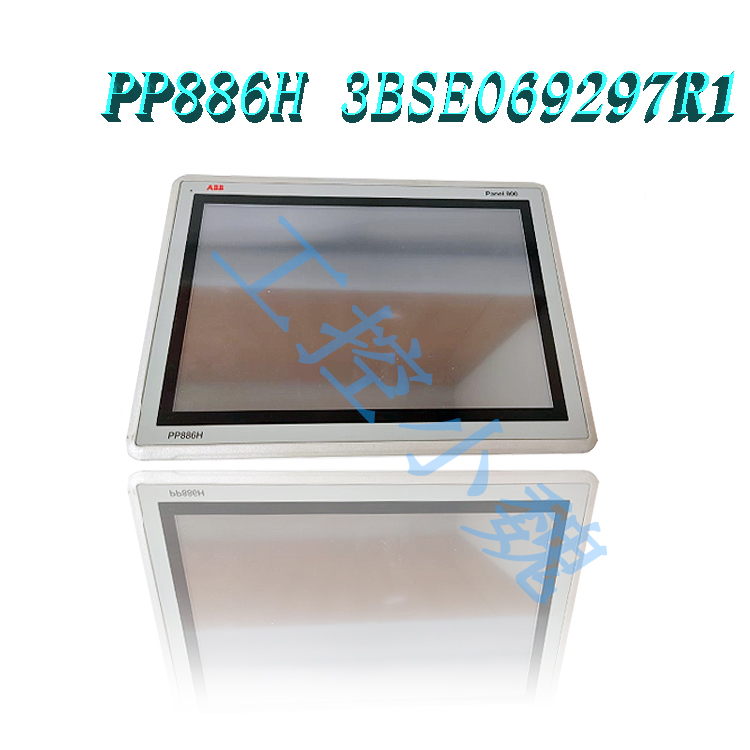
.jpg "PP886H 3BSE069297R1(1)")
.jpg "PP886H 3BSE069297R1(2)")
Description
Please note that all products on this site are specialized items subject to fluctuating market prices;
actual pricing is determined by the quote provided by customer service. As these are new products, the listed prices are not final;
please confirm details—such as the model, product specifications, and price—with customer service before placing an order.
New stock is available for sale; please contact customer service for details.
PP881 3BSE092978R1 Alternative Names:
HMI PP881 3BSE092978R1
PP881 3BSE092978R1 Operator Unit
Operator Touchscreen Panel PP881 3BSE092978R1
I. Basic Hardware Specifications
Screen: 10.1″ TFT LED backlit, 1024×600 resolution, 500 cd/m² brightness, resistive touchscreen
Processor: ARM9 1GHz; Memory: 1GB; Onboard Storage: 2GB SSD (1.5GB available)
Power Supply: 24V DC (18–32V DC range)
Interfaces: Dual 10/100M shielded Ethernet ports, 2× USB 2.0 ports
Protection: IP65 front panel, IP20 rear panel; powder-coated cast aluminum housing
Operating Temperature: -10°C to +60°C; Storage Temperature: -20°C to +70°C; Humidity: 5–85% (non-condensing)
Certifications: CE, UL, DNV, CCS (marine classification); suitable for marine and offshore platform applications
II. Operating Principle
The PP881 3BSE092978R1 is essentially an embedded HMI terminal for data acquisition and human-machine interaction; it is not a controller and does not perform logic processing:
Communication Layer: Establishes a client connection via Ethernet with ABB AC800M or Freelance controllers, or third-party PLCs. Server communication: Periodically reads process variables, alarms, and setpoints from controllers; also transmits operator commands (e.g., start/stop, parameter changes). Supports multiple protocols and simultaneous connection to multiple controllers.
Processing Layer: An ARM processor runs the Panel800 embedded firmware, processing and rendering the acquired field data against screen scripts pre-configured in the Panel Builder engineering software.
HMI Layer: A resistive touchscreen captures touch coordinates and translates them into actions such as button presses, slider adjustments, and numerical inputs. The screen refreshes trend charts, bar graphs, and alarm windows in real-time; an onboard RTC (Real-Time Clock) provides timestamps and supports historical alarm logging.
Storage Layer: Onboard SSD stores HMI project files, alarm logs, and historical trend data; a USB port allows for data export and project backups.
In short: The PP881 (3BSE092978R1) serves as the “window and control panel” for the control system. All control logic is executed within the PLC/DCS controllers, while the HMI is responsible solely for data visualization and issuing operator commands.
III. Core Functions
Process Visualization & Monitoring: Vector-based graphics supporting flow diagrams, bar graphs, dynamic coloring, and equipment status animations; real-time display of process measurements such as temperature, pressure, flow rate, and valve position. Supports multi-language switching, making it suitable for multinational projects.
Operator Control: Virtual buttons, manual/auto mode switching, setpoint entry, equipment start/stop, and recipe recall; supports hierarchical access control (Administrator/Operator/Read-only) and logs details of who performed which action and when.
Alarm Management: Real-time alarm lists, alarm prioritization, acknowledgment, and suppression; alarms are timestamped and stored locally for historical query and export.
Trend Recording: Real-time and historical trend curves; supports zooming to view process parameter changes over specific timeframes, facilitating fault analysis.
System Diagnostics: HMI… Features self-diagnostics for hardware and communication links; alerts on the panel for network disconnections, controller communication loss, or power anomalies facilitate rapid on-site troubleshooting to determine whether the issue lies with the HMI or the controller.
Supports project maintenance via SD/USB for uploading, downloading, backing up, and restoring projects; enables remote screen access; includes a built-in system information page for checking firmware versions and tag counts.
IV. Product Advantages
Native, deep integration with ABB DCS: Native optimization for System 800xA and Freelance allows direct tag importation without manual variable mapping; alarms, time synchronization, and event logging remain consistent with the DCS, significantly reducing configuration workload compared to third-party HMIs.
Industrial-grade ruggedness and environmental adaptability: Features a cast-aluminum housing and an IP65-rated front panel (dustproof and waterproof); operates in a wide temperature range (-10°C to +60°C) and withstands vibration; holds marine certifications, making it suitable for power plants, chemical facilities, and marine vessels. Equipped with a resistive touchscreen that allows operation while wearing thick gloves, making it ideal for environments with oil and dust.
Efficient configuration: Uses the accompanying Panel Builder software, featuring extensive pre-built graphics libraries and control templates, as well as distortion-free scalable vector graphics; tag counts can be licensed as needed, keeping project costs controllable.
Dual-port redundant communication: Two independent, shielded Ethernet ports enable network redundancy—automatically switching if one line fails—thereby enhancing operational reliability; this is a standard solution for DCS field operator stations.
Compact, all-in-one design: Designed for panel-mount installation with a shallow mounting depth; includes an integrated SSD, eliminating the need for additional storage cards to save projects and historical data.
V. Typical Application Scenarios
Power Industry: Local operation panels for power plant auxiliary equipment; operator stations for boilers and water treatment systems.
Chemical & Pharmaceutical: Local monitoring and operation for reaction vessels, wastewater treatment, and process pipelines.
Oil, Gas & Marine: On-site HMIs for marine propulsion systems, offshore platforms, and pump stations (DNV/CCS certified). Certification)
Pulp & Paper, Metallurgy: On-site process monitoring and recipe management for production lines.
Water/Wastewater Treatment Plants: On-site operation terminals for pumps, valves, liquid level monitoring, and chemical dosing systems.
Positioning: Field-level operator panel (not a control room workstation); suitable for cabinet-front mounting to facilitate on-site monitoring and operation by inspection personnel.
VI. Installation, Commissioning, and Usage Precautions
Installation
For panel-mount installation, ensure the front sealing gasket is intact and tightened evenly to maintain the IP65 rating; replace the gasket promptly if it shows signs of aging to prevent moisture or dust from entering the rear housing and causing damage.
Use an isolated 24V DC power supply and consider adding surge protection; the supply voltage must not remain below 18V or above 32V for extended periods, as this may cause repeated reboots.
Use shielded twisted-pair (STP) Ethernet cables with the shield grounded at one end only; keep cables away from variable frequency drives (VFDs) and high-power motor cables to avoid electromagnetic interference that could cause communication instability or packet loss.
The rear housing is rated IP20; install it inside a control cabinet and do not expose it to rain or water sprays. Avoid prolonged direct sunlight on the screen, as this accelerates backlight aging.
Configuration and Commissioning
Ensure the Panel Builder version matches the HMI firmware version; version incompatibility can lead to project download failures or display anomalies.
Communication Configuration: In an 800xA environment, pay attention to AS node licensing and tag count licensing; if the number of tags exceeds the licensed limit, the panel will trigger an alarm and lock certain functions.
Time Synchronization: It is recommended to enable NTP for synchronization with the DCS. Controller time synchronization ensures consistent timestamps for alarms and trends.
Touch calibration: Recalibrate the touchscreen after replacing the touch panel; avoid scratching resistive screens with sharp, hard objects.
Operation, Maintenance, and Faults
Cleaning: Wipe the front panel with a soft cloth and neutral detergent; do not spray alcohol or strong solvents directly onto the screen.
Storage: SSDs have a limited write lifespan; do not store historical trend data indefinitely—clear it periodically or export it to external storage.
Backup: Always back up the project locally on a computer; if the SSD fails, the project can be restored by simply downloading it again.
Prohibitions: Do not flash non-official ABB firmware; do not insert unknown USB drives into the rear USB port to prevent virus infections.
Environment: Operation in environments with condensation is strictly prohibited; if there are significant temperature fluctuations on-site, the cabinet requires dehumidification and heating.
Safety Points
HMI operation privileges are strictly tiered; add confirmation pop-ups for start/stop buttons controlling critical equipment. The HMI serves only as an operator interface and cannot replace hard-wired manual emergency stop circuits; safety interlocks must still rely on hardware circuits.
VII. Quick Fault Diagnosis (Simplified Troubleshooting for Engineers)
Black screen: First, check the 24V DC power supply and power terminals; then, check for backlight failure.
Display normal but unresponsive: The touch panel may be damaged, or touch calibration parameters may have been lost; recalibrate the screen.
Display active but no data/all measurement points show question marks: Check the network port, Ethernet cable, and controller communication status; the HMI itself is likely functioning correctly.
Random freezing or missed alarms: Usually caused by network interference or the number of tags exceeding the licensed limit.
Model recommendation:
PP865A
PP865A 3BSE042236R2
PP875
PP875 3BSE092977R1
PP877
PP877 3BSE069272R2
PP881
PP881 3BSE092978R1
PP886H
PP886H 3BSE069297R1
PP886 3BSE092980R1
PP825
PP825 3BSE042240R1
PP825A
PP825A 3BSE042240R3
PP836
PP836 3BSE042237R1
PP836A
PP836A 3BSE042237R2
PP845
more……
-300x300.jpg)
-300x300.jpg)
admin –
II. Screen Hardware Specifications
Display: 10.1-inch TFT LED backlit color screen, 16:10 widescreen
Resolution: 1280 × 800, 16 million true colors, 170° viewing angle
Brightness: 500 cd/m², adjustable backlight, strong light visible from the cabinet
Touch Type: Resistive industrial touch, resistant to oil, dust, and gloves
Physical Buttons: 6 customizable function buttons on the side of the unit (screen switching, alarm confirmation, emergency stop linkage, etc.)
III. Core Hardware Configuration
Processor: ARM industrial embedded processor
Memory: 128MB DDR2 RAM
Storage: 80MB built-in Flash + Micro SDHC memory card slot (engineering backup, data export)
Power Consumption: 21.6W
Power Supply: DC 24V (18~32VDC allowed) Wide Voltage
IV. Dimensions and Installation
Overall Dimensions: 292 mm (W) × 194 mm (H) × 52 mm (D)
Rack Opening Dimensions: 275 mm × 177 mm
Installation Method: Recessed panel mounting, supports VESA75 wall mount bracket
Net Weight: 1.65 kg
V. Full Interface Configuration (Rear)
Ethernet (2 independent RJ45 10/100M)
Port 1: Connects to AC800M/800xA controller via MMS protocol
Port 2: Host SCADA, Modbus TCP, Profinet IO
Serial Port Channels
COM1: RS232 (program download, serial peripherals)
COM2: RS422/RS485 (Modbus RTU, third-party instruments)
USB 2.0 Host ×2
U Disk backup engineering, alarm/trend record export, external mouse and keyboard connection
SD card slot, 24V power terminal
VI. Protection and Environmental Parameters
Front panel protection: IP65 / NEMA 4X (waterproof and dustproof, suitable for workshops and power plant cabinets)
Rear interface area: IP20 (inside the rack)
Operating temperature: -10℃ ~ +60℃
Storage temperature: -20℃ ~ +70℃
Humidity: 5%~85% RH, non-condensing
Vibration resistance: 5~500Hz, 0.7g, meeting the industrial conditions of power plants, water pumps, and compressors
Certifications: CE, UL 61010, DNV marine certification
VII. Supported Communication Protocols (Multi-brand compatible)
ABB native protocol
MMS (AC800M/800xA), AF100, Freelance, Modbus TCP/RTU
Third-party mainstream drivers
Profinet IO, EtherNet/IP, Modbus RTU, CANopen, GE Fanuc, Rockwell Automation, Siemens S7, and various inverter/instrument bus protocols, supporting simultaneous multi-channel connection to controllers from different brands.
VIII. Core Operation Functions
Process flow monitoring, manual parameter setting, equipment start/stop operation
Real-time alarm window + historical alarm storage (with timestamp and fault level)
Analog quantity trend curves, batch recipe management
User hierarchical permission management (operator/administrator/engineer)
Data export to USB flash drive, remote alarm email push
Multi-language switching, system real-time clock (RTC)
IX. Supporting Configuration Software
Panel Builder 800 (Windows platform)
Drag-and-drop screen configuration, built-in industrial library (valves, motors, instruments)
Offline simulation, download project to… PP881
Supports project backup, firmware upgrade, and touchscreen diagnostics
X. Typical Application Scenarios
Chemical/Hydropower/Gas Power Plant DCS Local Operation Station (with UNITROL excitation and gas turbine control system)
Water Treatment, Oil & Gas, Chemical Process Control
Marine Power Plant, Metallurgical Rolling Mill, Air Compressor/Refrigeration Unit PLC System
ABB AC500, AC800M Small and Medium-Sized Automation Cabinet
XI. Spare Parts Replacement Notes
Panel800 Series Size Differentiation:
PP875 (7″) / PP881 (10.1″) / PP883 (12.1″) / PP886 (15.4″), screen sizes are not interchangeable
The part number suffix R1 indicates the standard hardware version; 3BSE092978R1 is preferred for replacement.
After replacing with a new unit, the complete project screen and variable configuration must be downloaded via Panel Builder.
https://www.weikunfadacai1.com/product/rh924uq-foxboro/
https://www.weikunfadacai1.com/product/3bhe030579r0003-controller-abb/
https://www.weikunfadacai1.com/product/unitrol-1020-controller-abb/
https://www.weikunfadacai1.com/product/abb-unitrol-1020-uns0119a-zv1-3bhe030579r0003/
https://www.weikunfadacai1.com/product/unitrol-1020-3bhe030579r0003/
https://www.weikunfadacai1.com/product/abb-unitrol-1020-3bhe030579r0003/
https://www.weikunfadacai1.com/product/362a1052p004-flame-detector-honeywell-362a1052p004/
https://www.weikunfadacai1.com/product/abb-pp881-3bse092978r1/
admin –
Product Advantages
Native, deep integration with ABB DCS: Native optimization for System 800xA and Freelance allows direct tag importation without manual variable mapping; alarms, time synchronization, and event logging remain consistent with the DCS, significantly reducing configuration workload compared to third-party HMIs.
Industrial-grade ruggedness and environmental adaptability: Features a cast-aluminum housing and an IP65-rated front panel (dustproof and waterproof); operates in a wide temperature range (-10°C to +60°C) and withstands vibration; holds marine certifications, making it suitable for power plants, chemical facilities, and marine vessels. Equipped with a resistive touchscreen that allows operation while wearing thick gloves, making it ideal for environments with oil and dust.
Efficient configuration: Uses the accompanying Panel Builder software, featuring extensive pre-built graphics libraries and control templates, as well as distortion-free scalable vector graphics; tag counts can be licensed as needed, keeping project costs controllable.
Dual-port redundant communication: Two independent, shielded Ethernet ports enable network redundancy—automatically switching if one line fails—thereby enhancing operational reliability; this is a standard solution for DCS field operator stations.
Compact, all-in-one design: Designed for panel-mount installation with a shallow mounting depth; includes an integrated SSD, eliminating the need for additional storage cards to save projects and historical data.
https://www.weikunfadacai1.com/product/abb-pp881-3bse092978r1/