

Description
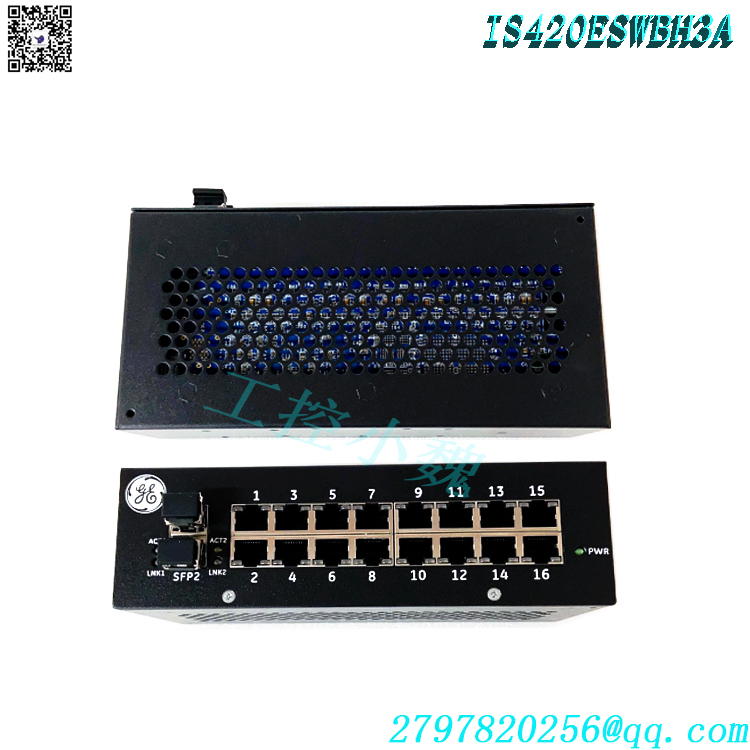
IS420ESWBH3A-C- Ethernet IONet Switch is available in stock which ships the same day.
IS420ESWBH3A-C- Ethernet IONet Switch comes in UNUSED as well as REBUILT condition.
To avail our best deals for IS420ESWBH3A-C- Ethernet IONet Switch, contact us and we will get back to you within 24 hours.
Product Overview
The IS420ESWBH3A-C is a dedicated IONet industrial unmanaged Ethernet switch designed for GE Mark VIe / Mark VIeS control systems. Part of the ESWB series, it features sixteen 10/100Base-TX RJ45 copper ports (with no fiber-optic ports). It is specifically designed to transparently transmit real-time control packets for safety-critical control systems—such as those for gas and steam turbines—serving as the core switching hardware for the IONet fieldbus network. It enables deterministic industrial Ethernet communication between controllers, distributed I/O racks, and HMIs, and is widely used within the safety control system architecture of power plant turbine units.
I. Operating Principle
The IS420ESWBH3A-C utilizes a store-and-forward Layer 2 switching architecture and complies with IEEE 802.3, 802.3u, and 802.3x Ethernet standards, providing a dedicated real-time data exchange channel for the Mark VIe IONet network. As an unmanaged switch, it lacks web-based configuration, VLAN, or QoS settings; switching logic is hard-coded in hardware, while control strategies are centrally managed by the Mark VIe controller.
Packet Identification and Addressing: It features a built-in 4K MAC address table that automatically learns the MAC addresses of controllers and I/O modules within the IONet network. Upon receiving an Ethernet packet, it reads the destination MAC address and forwards the packet directly to the target port, thereby preventing network-wide flooding and reducing network collisions. Data Buffering: Equipped with a 256KB hardware packet buffer supporting independent port buffering. When multiple ports handle concurrent traffic, the switch queues and buffers packets, forwarding them in a First-In-First-Out (FIFO) sequence. This suppresses broadcast storms, prioritizes the transmission of critical control messages (such as unit protection and interlocking signals), and prevents the loss of control commands due to network congestion.
Port Auto-Negotiation: All RJ45 ports support 10/100 Mbps auto-negotiation, full/half-duplex adaptation, and automatic HP-MDIX detection. This eliminates the need to distinguish between straight-through and crossover cables and automatically matches communication parameters with connected devices. It also supports IEEE 802.3x flow control; when the receiving buffer is full, a pause frame is sent to the transmitter to halt packet transmission, thereby preventing packet loss.
Redundant Power Supply Logic: Dual 28V DC power inputs utilize a diode-based OR-gate redundancy circuit for parallel operation. If one power source fails or disconnects, the other seamlessly takes over, ensuring uninterrupted IONet network communication and meeting the safety requirements for continuous operation of turbine control systems.
Hardware Status Indication: Each port features a dual-color LED indicating link status, data activity, duplex mode, and communication speed. A system power LED provides real-time feedback on the power supply status, offering an intuitive hardware-level view of network operations without requiring software monitoring.
II. Core Product Advantages
Native System Adaptation and Deterministic Real-Time Communication: Specifically developed for the IONet network of GE Mark VIe/VIeS turbine control systems—not a general-purpose IT switch. Packet forwarding latency is stable and controllable, meeting real-time requirements for safety control loops such as unit protection, overspeed protection, and vibration interlocking, while avoiding the random latency and packet jitter issues common in commercial switches.
Rugged Industrial Hardening: Built to G3 environmental standards with a wide operating temperature range and fanless natural convection cooling. It withstands vibration, shock, and electromagnetic interference, ensuring stable long-term operation in the harsh environments of turbine halls—characterized by high cabinet temperatures, intense electromagnetic noise, and continuous vibration—and is ideally suited for the sealed environments of generator control cabinets.
Redundant Power Design: Features dual DC power inputs with automatic failover to eliminate single points of power failure. Network communication remains uninterrupted if one power source fails, enhancing the availability of the entire control system and preventing accidental unit trips caused by switch power loss.
High Port Density: Equipped with 16 RJ45 ports, a single switch can connect multiple distributed I/O racks and controllers. This reduces the number of network nodes, simplifies the setup of the IONet star topology, and minimizes potential points of failure associated with intermediate network equipment.
Unmanaged, Configuration-Free Design: Hardware-embedded switching logic eliminates the need for IP, VLAN, or network parameter configuration—the device is operational immediately upon power-up. It removes the risk of network failure due to human error in parameter settings; spare part replacement requires only checking DIP switch and jumper settings, making it ideal for safety-critical control systems.
Hardware-Based Storm Suppression: Limits the forwarding rate of broadcast packets at the hardware level. This prevents broadcast storms—triggered by I/O anomalies or cable short circuits—from consuming bandwidth needed for control traffic, thereby ensuring the availability of critical unit protection communication channels.
Flexible Installation: Supports standard DIN-rail mounting or cabinet panel mounting, complying with power plant control cabinet installation standards and facilitating quick and easy replacement of spare parts. III. Applicable Industries and System Functions
Applicable Industries
Thermal power generation, gas-fired combined-cycle power plants, combined heat and power (CHP) plants, oil and gas gas-turbine driven units, industrial steam turbines, and marine gas turbine propulsion control systems; primarily used in projects utilizing GE Mark VIe/Mark VIeS safety control systems.
Functions within the Control System
Establishes the IONet core communication network: Acts as a relay node for the Mark VIe system’s IONet network, connecting main controllers, remote I/O racks, process data acquisition modules, and operator HMIs. It builds a distributed turbine control LAN to facilitate the issuance of control commands and the bidirectional transmission of field analog/digital signals, unit status data, alarms, and protection signals.
Ensures communication for unit safety protection links: Safety logic signals—such as unit overspeed protection, vibration protection, temperature interlocks, and emergency shutdowns—are transmitted via the IONet network. The switch ensures stable packet forwarding, guaranteeing that protection signals reach the controller reliably and with low latency; this prevents protection failure due to communication interruptions and mitigates the risk of major equipment accidents.
Aggregates distributed I/O data: Collects measurement data from multiple I/O module groups distributed across field cabinets and forwards it to the Mark VIe main controller. Simultaneously, it transmits control adjustment commands from the controller to field actuator I/O modules, enabling closed-loop regulation of turbine speed, fuel valves, and inlet guide vanes.
System status monitoring and diagnostic data transmission: Transmits diagnostic information—such as module self-test results, network faults, and power supply anomalies—to controllers and HMIs. This enables operations and maintenance personnel to monitor the health of the IONet network in real-time and rapidly pinpoint network issues such as broken connections or port failures. Supports unit start/stop and dynamic regulation. During dynamic operating conditions—such as unit startup, load ramping, and load rejection—it ensures uninterrupted exchange of massive real-time measurement data and control commands, maintaining stable closed-loop control of the gas/steam turbines.
IV. Standard Operating Procedures
Important Note: This device is a component of the power plant safety control system. All installation and replacement operations must be performed while the unit is shut down, the system is de-energized, and safety isolation/tagout procedures have been executed. Hot-swapping (plugging/unplugging while powered) poses a risk of IONet network interruption and unit tripping.
Spare Part Verification and Parameter Replication: Before replacing the module, record the DIP switch and jumper settings of the original IS420ESWBH3A-C unit. Strictly replicate these settings on the new spare part to ensure the IONet network topology identification matches.
Hardware Installation and Securing: Snap the switch onto the standard DIN rail and lock it in place; ensure the module is securely fastened to prevent loosening due to vibration. Leave sufficient clearance above and below the unit to allow for natural convection cooling, and do not obstruct the ventilation areas on the housing.
Power Supply Wiring: Connect two redundant 28V DC power sources according to the schematics. Observe correct polarity, securely tighten terminals, and properly ground cable shields. Source the two power inputs from independent circuits to achieve true redundancy.
Network Cable Connection: Use industrial-grade shielded twisted-pair cables. Connect the network cables from the Mark VIe controller and I/O racks to the corresponding RJ45 ports; HP-MDIX auto-negotiation eliminates the need to distinguish between wiring sequences. Ground the shield of each cable at a single point only to prevent ground loops.
Power-Up and Status Check: After completing all wiring, verify that there are no short circuits, remove safety isolation measures, and power up the system sequentially. Observe the main power LED and the Link/Act indicators for each port. A steady port light indicates an established link, while a flashing light indicates data transmission/reception; if there is no link, check the network cable, connectors, and the status of the module at the other end.
System Verification Testing: After powering up, check the IONet network status via the Mark VIe HMI or controller diagnostic interface to confirm that all I/O nodes are communicating correctly, with no packet loss or communication alarms. Conduct single-point network failure tests to verify that dual power supply switching and single-port cable disconnection do not disrupt overall IONet network operation.
Shutdown and Removal Procedure: Shut down the unit and apply lockout/tagout (LOTO) procedures. First, disconnect the network cable; next, remove the power wiring; finally, detach the module from the DIN rail. Hot-plugging (connecting or disconnecting) the RJ45 network port while the device is powered on is strictly prohibited.
V. Usage Precautions
Strictly Prohibit Hot-Plugging: The IS420ESWBH3A-C is a network device for safety control systems; hot-plugging network ports or modules will momentarily interrupt IONet communication, potentially triggering a protective trip in a running unit and resulting in downtime losses.
Grounding Standards and Prevention of Ground Loops: The shield of the shielded twisted-pair cable must be grounded at a single point only; grounding at both ends is prohibited. Poor grounding can introduce common-mode interference, leading to hard-to-reproduce latent faults such as sporadic packet loss or intermittent communication drops.
Environmental and Thermal Management: Keep the interior of the cabinet clean; accumulations of dust or oil can impair heat dissipation. The device relies on passive (fanless) cooling, so maintain ventilation gaps above and below the module and avoid stacking multiple devices tightly together. Do not use the device in environments prone to condensation or corrosive gases.
Network Cable Selection: Industrial-grade shielded twisted-pair cables must be used. Standard consumer-grade cables lack sufficient interference resistance and are prone to communication anomalies in the high-electromagnetic-interference environments typical of power plants. Ensure RJ45 connectors are securely crimped to prevent loosening due to vibration. Prohibition on Hardware and Firmware Modification: This switch is an unmanaged device with fixed hardware and firmware; it lacks a login configuration interface. Do not attempt to flash the firmware or modify internal circuitry. Such alterations will invalidate the Mark VIe system certification and result in the loss of safety qualification.
Spare Part Version Matching: When replacing a spare part, ensure the hardware version and model suffix (e.g., IS420ESWBH3A-C) match exactly. Hardware versions are not directly interchangeable, as mismatches may lead to IONet protocol compatibility issues.
Fault Handling Principles: In the event of port anomalies or communication alarms, prioritize checking network cables, terminals, grounding, and power supply. Conclude that the module hardware is damaged only after confirming that all external wiring is functioning correctly. Do not disassemble or repair faulty modules on-site; instead, return them to the factory for inspection in accordance with spare part procedures.
Safety Control: This device is safety-critical hardware for turbine systems. Installation and maintenance must adhere to the power plant’s work permit system and strictly follow power-off, voltage verification, and Lockout/Tagout (LOTO) procedures to prevent accidental energization.
Warehouse model recommendation:
PCD235B101 3BHE032025R0101 ABB
9907-205 MSLC/DSLC Hand Held Programmer
9907-018 series 2301A LSSC
9907-163
9907-163
9907-175
9907-149
9907-162
9907-164
9907-165
9907-167
3142399-801
MMB01-REV.1-3-2099-A
ESM-204-K-999-1-001
IS420UCSBH4A
IS420UCSBH1A
IS420UCSBH4A
IS420UCSBH1A
IS420UCSBH1A
GE IS420UCSBS1A
IS420UCSBH3A-UCSB
IS420UCSBS1A
IS420UCSBH1A-UCSB
IS420UCSBH4A
More…


admin –
Product Description
Industrial Ethernet Switch IS420ESWBH3A-C is part of the Mark VIe Safety Control System designed by General Electric. This switch does not have any fiber ports but has sixteen copper ports, the copper ports are 10/100Base-TX RJ45 ports. The primary operation of the switch is to perform as a level one Ethernet switch which will center on the capability to buffer multicast and broadcast packets. There should be enough space to allow for the buffer of one packet per port; if multiple incoming streams are being sent to the switch, it can only accept one incoming stream out of the multiple streams and will buffer the remaining streams for later transmission.
There are LED indicators on the IS420ESWBH3A-C switch. There is a power LED and the remaining LEDs are activity and link functions. When the link LED is solid yellow it indicates that a 10 MB link is being used and when solid green a 100 MB link is being used, and no LED light indicates that there is no link. The colors for the activity LED are also green and yellow but they will flash, when the LED flashes green it indicates that the activity is at full duplex and when flashing yellow the activity is at half duplex.
admin –
I. Product Positioning
The IS420ESWBH3A-C is a dedicated industrial Ethernet switch for the GE (now GE Vernova) Mark VIe / Mark VIeS control system series, belonging to the ESWB hardware platform. Within the system, it serves as the core switching node for the IONet (I/O network), physically connecting Mark VIe controllers and distributed field I/O modules (such as terminal boards and modules within I/O racks) to the same real-time control network. It is important to note that within Mark VIe / Mark VIeS systems, IONet switches must be genuine GE units (i.e., the ESWA/ESWB series); standard commercial switches cannot be used as substitutes, as this is a strict requirement for system real-time performance and security.
Meaning of the model suffix: “ESWB” indicates the 16-port hardware configuration; “H3A” denotes a configuration with only copper ports and no fiber-optic ports; the “-C” suffix typically corresponds to a variant with conformal coating for use in harsher field environments (please refer to the official GE ordering data sheet for specific details).
II. Hardware and Ports
16 x 10/100Base-TX copper ports with RJ-45 (8P8C) connectors, compatible with Cat 5e UTP network cables;
This model (H3A) has no fiber-optic ports; if the site requires fiber-optic uplinks (multi-mode / single-mode LX10), other versions such as H1A, H2A, H4A, or H5A must be selected;
Full/half-duplex auto-negotiation; 10/100 Mbps adaptive speed;
HP-MDIX auto-crossover detection—supports both straight-through and crossover cables, eliminating the need to select specific wiring sequences during field installation;
Supports IEEE 802.3 / 802.3u / 802.3x standards, including flow control. III. Power Supply and Reliability Design
Rated 24/28 VDC, 1 A maximum;
Two independent power inputs are provided via terminal blocks TB1 and TB2 on the front panel, utilizing Diode-OR logic for power redundancy—ensuring uninterrupted switch operation even if one power source fails, a critical availability feature for power plant and gas turbine control cabinets;
Uses Phoenix Contact (MC 1.5/S-STF-3.81) pluggable connectors for power input (two connectors included);
Fanless design with natural convection cooling—eliminating moving parts reduces potential points of failure and makes the unit suitable for dusty environments.
IV. Data Forwarding Capability
Minimum 256 KB packet buffer to absorb transient traffic spikes during IONet broadcast storms and prevent packet loss;
4K MAC address table, sufficient to handle address learning for all I/O nodes within a typical Mark VIe cabinet;
Each port features a dual-color LED indicating Link, Activity, Duplex, and Speed status; a separate power status LED is also provided, making physical layer troubleshooting intuitive and straightforward. V. Environment and Certification
Operating temperature: -40 to +70°C; storage temperature: -40 to +85°C; suitable for harsh environments such as gas turbine enclosures and outdoor skid-mounted installations;
Explosion-proof rating: Non-interferring, Class 1 Div 2 / Class 2 Zone 2 / ATEX hazardous area capability (specifics to be evaluated per GEH-6861 guidelines);
Certified to G3 corrosion resistance standards (ISA), resistant to industrial corrosive gases;
Dimensions: 18.8 × 8.6 × 5.6 cm (H×W×D); DIN rail mounting—note that rail clips are not included and must be ordered separately: use 259B2451BVP1 for parallel mounting along the long side of the rail, and 259B2451BVP4 for vertical mounting.
VI. Engineering Application Highlights
In the Mark VIe network architecture, IONet serves as the real-time I/O control network; it is isolated from the upper-level UDH (Unit Data Highway) used for HMI interaction and the PDH (Plant Data Highway) used for historical data collection—IONet switches carry only real-time data traffic between controllers and I/O modules;
This unit is an unmanaged Layer 2 switch; it is plug-and-play and requires no configuration, aligning with the control system’s design philosophy of “simplicity and reliability”;
The product series is currently in the “Active” lifecycle stage (still in production and available for sale); replacement spares can be ordered directly using the original model number (the official replacement part number is also IS420ESWBH3A). In short, the IS420ESWBH3A-C serves as the dedicated data channel for the Mark VIe control system’s IONet; featuring 16 copper ports, redundant power supplies, a wide operating temperature range, explosion-proof capabilities, and a plug-and-play design, it ensures deterministic data forwarding for real-time communication between controllers and I/O, making it a standard network component in control cabinets for gas turbines, steam turbines, and combined-cycle systems.
https://www.weikunfadacai1.com/product/abb-pp881-3bse092978r1/
https://www.weikunfadacai1.com/product/362a1052p004-flame-detector-honeywell-362a1052p004/
https://www.weikunfadacai1.com/product/rh924uq-foxboro/
https://www.weikunfadacai1.com/product/tioc-555hd-safety-high-density-analog-input-module-honeywell-tioc-555hd/
https://www.weikunfadacai1.com/product/honeywll-tc-xxxxx1/
https://www.weikunfadacai1.com/product/woodward-easygen-3500xt-8440-2085/
https://www.weikunfadacai1.com/product/woodward-easygen-3500xt-8440-2085/
https://www.weikunfadacai1.com/product/abb-gfd563a102-3bhe046836r0102/
https://www.weikunfadacai1.com/product/is420eswbh3a-c-ge/