
Description
All products on this site are specialized items subject to fluctuating market prices.
Please rely on the quote provided by customer service, as the listed prices are not final.
Before placing an order, please confirm details such as the model, product specifications, and price with customer service.
Please contact customer service for further information regarding available units.
IS420UCSBH4A – Alternative Designations:
Switch IS420UCSBH4AA
Control System Module IS420UCSBH4A
Programmable Controller IS420UCSBH4A
I. Product Overview
The IS420UCSBH4A is a UCSB (Universal Control System Block) core controller module within the General Electric (GE) Mark VIe turbine control system. Serving as the system’s primary computing unit, it is designed for high-reliability industrial applications such as gas turbines, steam turbines, and generator excitation control. The module features an Intel EP80579 processor (clocked at 1066 MHz), 256 MB of DDR2 SDRAM, and onboard flash storage. It runs the QNX Neutrino real-time multitasking operating system and communicates with distributed I/O units via a multi-port IONet dedicated Ethernet interface, enabling high-speed, precise equipment control and protection.
II. Operating Principle
1. Hardware Architecture and Computing Core
The IS420UCSBH4A utilizes a high-performance, low-power processor as its computing core and features a modular design that integrates memory/storage, power management, communication interfaces, and a thermal management system. The module operates on a wide-range DC power supply (18–30 V DC; nominal 24/28 V DC) and ensures stable operation in industrial environments through a passive, fanless cooling design. At the hardware level, it supports redundant deployment; in dual-controller or Triple Modular Redundant (TMR) architectures, all I/O networks connect simultaneously to every controller. This ensures that if a single controller is shut down for maintenance, there is no loss of system input data and no interruption to control logic execution.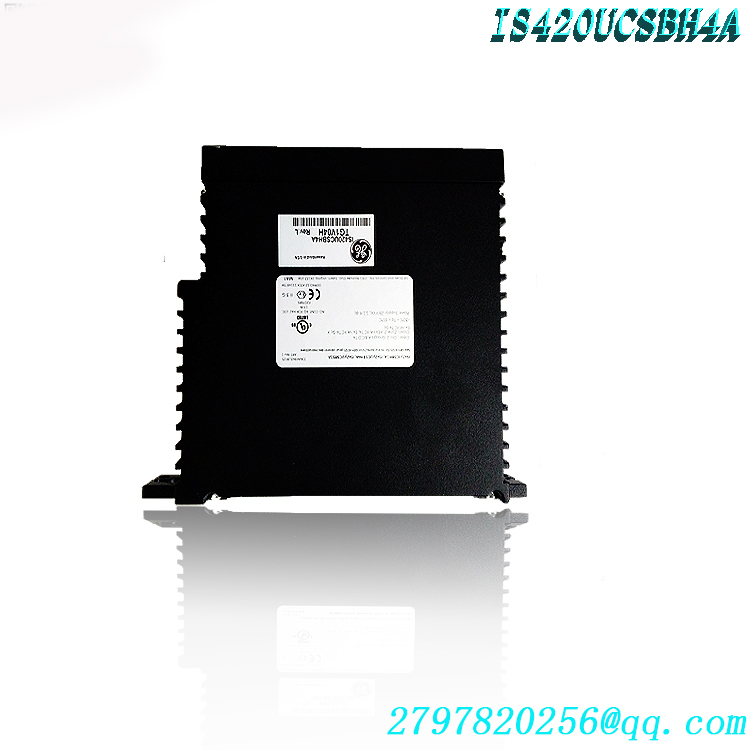
2. Real-Time Operating System and Control Logic Execution
The module runs the QNX Neutrino real-time multitasking operating system, designed specifically to meet the high real-time and high-determinism requirements of industrial control. It can execute multiple control algorithms in parallel—such as speed regulation, load control, sequential logic, fault monitoring, and safety protection. The system acquires field signals based on preset control cycles and outputs control commands after processing; response times are in the millisecond range, meeting the high-speed control demands of rotating turbine equipment.
3. IONet Distributed Communication Mechanism
The IS420UCSBH4A communicates with distributed I/O modules in the system via multi-port IONet dedicated Ethernet interfaces. IONet is an industrial Ethernet protocol exclusive to the GE Mark VIe series; it utilizes the IEEE 1588 Precision Time Protocol (PTP) to achieve network-wide clock synchronization with an accuracy of ±100 microseconds, ensuring temporal consistency across all I/O signal acquisition and control outputs. Unlike traditional backplane I/O architectures, this controller does not directly host application I/O; instead, it enables distributed remote I/O deployment via the network, accommodating requirements for installing I/O modules close to field equipment.
4. Fault Monitoring and Protection Mechanisms
The controller features built-in system-wide status monitoring logic. It captures real-time data on its own operational status, communication status, and field I/O signal states, enabling rapid identification of—and tiered responses to—anomalous signals, communication interruptions, and hardware faults. In protection scenarios, it can trigger preset protective actions—such as safe shutdowns and load shedding—to prevent equipment damage; simultaneously, it records fault logs and waveform data to facilitate subsequent fault tracing and analysis.
III. Core Advantages
1. High Real-Time Performance and Computing Power
Equipped with a dedicated industrial-grade processor and the QNX real-time operating system, it stably executes complex multivariable control algorithms and protection logic. It meets the millisecond-level control response requirements of high-speed rotating equipment (such as gas and steam turbines), enabling precise speed control and load regulation.
2. High Reliability and Redundant Architecture
It supports single, dual, and triple-modular redundant configurations with a switchover time of less than 50ms, eliminating single points of failure. The hardware utilizes industrial-grade components and a fully sealed structure; having passed rigorous vibration, shock, and electromagnetic compatibility (EMC) tests, it ensures long-term, fault-free operation in high-interference, heavy-duty industrial environments.
3. Wide Environmental Adaptability
Featuring a passive, fanless cooling design, it operates within a temperature range of -30°C to +65°C (storage: -40°C to +85°C) and supports non-condensing humidity levels of 5%–95%. It is suitable for harsh operating environments—such as power plants, offshore platforms, and remote pumping stations—and operates stably without the need for additional temperature control facilities.
4. Modularity and Ease of Maintenance
Designed for standard DIN-rail mounting with pluggable interfaces, it supports hot-swapping, which minimizes system downtime during on-site module replacement. Standardized hardware interfaces and software protocols ensure seamless compatibility with the full range of Mark VIe I/O modules, human-machine interfaces (HMIs), and upper-level systems, facilitating system expansion and upgrades.5. Functional Safety Compliance
Compliant with the IEC 61508 functional safety standard, the unit meets safety control requirements for SIL 2 and SIL 3 levels. It is suitable for safety protection needs in hazardous areas and critical processes, providing compliant safety assurance for personnel, equipment, and production workflows.
IV. Industry Applications and Core Functions
1. Power Generation Industry
The IS420UCSBH4A serves as a core control component for gas turbines, steam turbines, and combined-cycle power plants, handling functions such as unit speed regulation, load control, excitation regulation, start/stop sequence control, and safety protection. By optimizing air-fuel ratios, steam parameters, and unit load distribution in real-time, it enhances thermal efficiency and power generation stability. It also enables automated, unattended operation to reduce O&M costs, acting as the central computing unit for control systems in thermal and gas-fired power plants.
2. Oil and Gas Industry
It is applied to prime mover control for catalytic cracking units in refineries, compressor stations in oil and gas fields, and generator sets on offshore platforms. In petrochemical process scenarios, it implements multivariable predictive control to stabilize product yields and process parameters. In remote locations like offshore platforms, its high reliability and wide temperature adaptability ensure the continuous operation of generator sets and process equipment, thereby reducing the frequency of on-site maintenance.
3. Industrial Captive Power Plants and Heavy-Duty Generator Sets
Used for controlling steam and gas turbines in captive power plants across industries such as metallurgy, papermaking, and chemicals, it enables dynamic adjustment of plant electrical loads and islanding protection to ensure stable power supply. Additionally, it supports excitation control and protection systems for various heavy-duty industrial generator sets, extending equipment service life and enhancing fault self-recovery capabilities. 4. Legacy System Retrofitting and Spare Parts Upgrades
As a universal controller for the GE Mark VIe series, this unit serves as a direct replacement for older controller modules within the same family. It is suitable for the maintenance, retrofitting, and upgrading of existing Mark VIe, EX2100e excitation systems, and LS2100e protection systems. It enhances control performance and operational reliability—and extends the overall lifecycle of the industrial control system—without requiring a major overhaul of the system architecture.
V. Operating Procedures
1. Installation and Deployment Steps
Pre-installation preparation: Verify that the cabinet DIN rail meets Mark VIe standards and that the on-site power supply voltage is stable within the 18–30V DC range. Prepare tools such as an anti-static wrist strap and an insulated screwdriver, and clear the installation area of dust and debris.
Rail mounting: Slide the module vertically onto the DIN rail; a clicking sound indicates the locking mechanism has engaged and the module is correctly seated. Maintain a heat dissipation gap of at least 10mm between modules and keep the unit away from equipment that generates strong electromagnetic interference, such as variable frequency drives (VFDs) and transformers.
Wiring: Connect the DC power supply according to terminal markings (observing positive and negative polarity), plug the IONet shielded twisted-pair cable into the corresponding Ethernet port, and tighten terminal screws securely to prevent loose connections. After wiring, verify cable labels and ensure there is no risk of short circuits.
Pre-power-up check: Confirm that all wiring is secure and correctly connected, the module is firmly mounted, and no metal debris remains in the vicinity.
2. Parameter Configuration and Commissioning
Establish a communication connection with the controller via the RS-232 console port or Ethernet port using GE ToolboxST or Proficy Machine Edition programming software. Add the IS420UCSBH4A module to the software and assign a device address; configure I/O signal types, control logic, protection thresholds, and communication parameters according to site process requirements.
Download the configuration program to the controller and perform offline simulation testing to verify the correctness of the control logic and protection actions; switch to online operation mode after the simulation passes.
Start the unit and gradually apply the load; monitor fluctuations in control parameters and fine-tune PID parameters and control gains until the unit operates stably and control accuracy meets specifications.
3. Operation and Monitoring
During normal operation, the module’s power indicator remains steadily lit, the run indicator flashes rhythmically, and the IONet interface indicators flash to reflect normal communication status.
Use the supervisory monitoring system to view real-time operating parameters—such as unit speed, load, temperature, and pressure—as well as controller CPU load, memory usage, and communication status.
Periodically review system alarm logs and event records; address early warning information promptly to prevent faults from escalating.
VI. Precautions
1. Safe Operation Guidelines
Before handling module hardware, implement electrostatic discharge (ESD) protection measures—such as wearing an anti-static wrist strap—to prevent electrostatic damage to internal chips.
Unless the system supports hot-swapping, disconnect the system power supply before replacing hardware to prevent equipment damage or unintended actions caused by live operation.
Do not attempt to disassemble or repair the module’s internal circuitry yourself. The module utilizes precision surface-mount technology; field repairs cannot guarantee performance or safety standards. Replacements must be made using GE-authorized spare parts.2. Operation and Maintenance Essentials
Periodically check the tightness of wiring terminals every three months and clean accumulated dust from the module’s heat sink fins to ensure unobstructed ventilation, thereby preventing overheating that could lead to performance throttling or system crashes.
Regularly back up controller configuration programs and fault logs to prevent configuration loss during module replacement; use only official GE-released versions for system firmware upgrades, and do not use third-party modified firmware.
For systems with redundant configurations, periodically test the redundancy switchover function; verify the synchronization status and switchover response time of the standby controller to ensure it can successfully take over operations in the event of a failure.
3. Troubleshooting Tips
In the event of a communication interruption, prioritize checking IONet cable connections, switch port status, and IP address configurations to rule out physical link issues and address conflicts.
If the controller fails to start, use the status indicator lights to identify the failure stage (startup failure vs. application failure) and consult log codes to pinpoint whether the issue is hardware- or software-related.
If abnormal control deviations occur, check the accuracy of I/O signal acquisition and controller algorithm parameters, and verify that field sensors and actuators are functioning correctly.
Model recommendation:
GE IS420ESWBH3A
IS420ESWBH3A-C GE
IS420ESWBESWB GE
IS420ESWAH1A GE
IS420ESWBH3A-ESWA GE
IS420ESWAH2A GE
IS420ESWBH3A GE
IS420ESWBH3AE GE
IS420ESWAH3A GE
GE IS420ESWBH1A
NI SCXI-1000
A100C08013.0100-0934
CMA-120 BASIC
IS200ESELH1A
IS220UCSAH1A
IS200AEPGG1AAA
IS200TSVCH2AED
IS215UCCCM04AB
IS220PDIOH1A
IS220PPROS1B
IS200EPMCH1
IS215UCCAH3A
IS200JPDGH1A
IS420UCSBH1a
IS415UCVHH1A
IS215UCVHM06A
IS415UCVHH1AB
IS420UCSCS2A-B-V0.1-A
IS41ySUAAH1A
IS410BAPBH1A
IS41yJPDEG1A
IS41yJPDDG4A
more……

admin –
Controller IS420UCSBH4A is another UCSB controller produced by General Electric for the Mark VIe series. According to the description, the controller can operate on the EX2100e, LS2100e, and Mark VIe series running on the 1066 MHz EP80579 Intel processor. The EP80579 processor is used to assist applications that require high reliability and speed. This model is similar to previous UCSB controllers, except for the processors mentioned above, which all use the same processor type but run on different MHz.
admin –
Model: IS420UCSBH4A Full Name: UCSB Universal Control System Blade Platform: Mark VIe / Mark VIeS Brand: GE Vernova (formerly GE Power) Positioning: Core computing controller (CPU blade) for turbine control systems, main control unit for gas turbines/steam turbines, capable of forming a TMR triple-redundant control architecture, and working collaboratively with the IS220PPRAS1B (ETS overspeed protection I/O) you previously inquired about via IONet networking.
I. Core Hardware Specifications
Processor: Intel EP80579, 1066MHz
Memory: 256MB DDR2 ECC error-correcting memory
Local Storage: Onboard NAND Flash, no built-in battery design
Operating System: QNX Neutrino hard real-time RTOS
Power Supply: Nominal DC24V; Peak power consumption 28.7W, typical 17.3W
Cooling: Passive fanless heatsink
Operating Temperature: -30℃ ~ +65℃
Certifications: UL Class I Div 2, CE, suitable for hazardous areas in power plants
II. Panel Interfaces (Standard 5-channel RJ45)
IONet A / IONet B (dual redundant I/O bus) connects to all Mark VIe I/O Packs: IS220 series (PPRAS1B, PPROS, AI/DI/DO cards), proprietary real-time industrial Ethernet, IEEE1588 clock synchronization
ECN A/ECN B (External Control Network) connects to HMI, Engineer Station ToolboxST, DCS, and Historical Server.
SERV: Local debugging port (engineers connect directly to download programs and perform diagnostics).
Architectural Features: Distributed I/O, independent of backplane bus; controllers and I/O modules are networked remotely via network cables.
III. Main Functions
Control Logic Operation Core: Executes gas turbine/steam turbine speed regulation, load control, start-up sequence, fuel control, and excitation coordination (with EX2100e); handles OPC and interruption interlocking logic.
TMR Triple Redundancy Control: Three IS420UCSBH4A modules are installed in the cabinet for parallel operation and two-out-of-three voting; seamless switching in case of single controller failure avoids erroneous operation/failure to operate.
IONet Network Management: Polls and collects data from all I/O modules, issues output commands, and continuously diagnoses I/O card disconnections and hardware faults (such as IS220PPRAS1B speed channel fault reporting).
SOE event sequence recording, trend acquisition, and alarm management.
System hardware self-diagnosis: Monitoring the health status of CPU, memory, network links, and I/O communication; uploading fault codes to the HMI.
Cross-system communication: Supports Modbus TCP and GE SRTP protocols for data exchange with the plant-level DCS.
IV. Typical Application Scenarios
Heavy-duty gas turbines (9E/9F/9HA), steam turbines, and combined cycle units main control
EX2100e excitation control system main controller
Matching IS220PPRAS1B overspeed protection I/O, forming a complete steam turbine/gas turbine protection chain
Mark VIeS safety-related controls (SIL2/SIL3 system-level applications)
V. Version Differentiation and Spare Parts Interchange (Maintenance Focus)
Sequential Versions within the Same Series
IS420UCSBH1A / H3A: Earlier versions (600MHz) with lower computing power
IS420UCSBH4A: 1066MHz version with enhanced computing power, used for complex large-scale units and multi-point I/O projects
Interchange Notes
H4A is backward compatible, but the ToolboxST firmware version must match; direct connection is highly likely to result in a Hardware Mismatch report.
IS420UCSBH4A ≠ UCSE series (IS420UCSExxxx) hardware slots are not interchangeable and cannot be mixed.
Suffixes 4A, 4B, and 4C indicate minor hardware iterations and are generally interchangeable within the same project (preferably with the same suffix).
VI. System Hierarchy with IS220PPRAS1B (previously listed)
Three IS420UCSBH4A units (main controller TMR)
↕ IONet Dual Network
Three IS220PPRAS1B units (triple redundancy overspeed protection I/O, MPU speed acquisition, hardware interruption output). The UCSB is responsible for the entire unit’s regulation logic; the PPRA I/O is responsible for independent hardware-level overspeed backup protection, forming a dual-layer protection system of regulation system + independent safety protection. VII. Common Fault Phenomena: SERV/IONet light flashing abnormally: Network cable or switch IS420ESWBHxx fault. Controller Fault light constantly on: Firmware incompatibility, ECC memory error, Flash corruption. I/O Comm Loss: Communication interruption with IS220PPRAS1B; check IONet link and TREA terminal block.
https://www.weikunfadacai1.com/product/is420ucsbh4a-ge/
admin –
1. Safe Operation Guidelines
Before handling module hardware, implement electrostatic discharge (ESD) protection measures—such as wearing an anti-static wrist strap—to prevent electrostatic damage to internal chips.
Unless the system supports hot-swapping, disconnect the system power supply before replacing hardware to prevent equipment damage or unintended actions caused by live operation.
Do not attempt to disassemble or repair the module’s internal circuitry yourself. The module utilizes precision surface-mount technology; field repairs cannot guarantee performance or safety standards. Replacements must be made using GE-authorized spare parts.2. Operation and Maintenance Essentials
Periodically check the tightness of wiring terminals every three months and clean accumulated dust from the module’s heat sink fins to ensure unobstructed ventilation, thereby preventing overheating that could lead to performance throttling or system crashes.
Regularly back up controller configuration programs and fault logs to prevent configuration loss during module replacement; use only official GE-released versions for system firmware upgrades, and do not use third-party modified firmware.
For systems with redundant configurations, periodically test the redundancy switchover function; verify the synchronization status and switchover response time of the standby controller to ensure it can successfully take over operations in the event of a failure.